What to practice
- Select substitution or an allowed algebraic rewrite and verify by differentiation
Chapter 15's basic table handles sums of powers, exponentials and the standard trigonometric forms. Many integrands are disguises: a composite function sitting next to its inner derivative, or a quotient that becomes basic once it is rewritten. This chapter adds the AB tools, substitution, long division and completing the square, and a routine for choosing among them. Every tool reverses a derivative rule, so every answer can be checked by differentiating it.
Substitution reverses the chain rule (topic 6.9)
The chain rule says . Read backward:
Substitution makes the pattern visible. Let . Then , and the integral becomes .
- Choose as an inner expression whose derivative appears as a factor, up to a constant multiple.
- Write and solve for the factor that is actually present.
- Rewrite every part of the integrand; no may remain.
- Integrate in , return to , and differentiate to check.
Worked example 16.1: the derivative is already there
Find .
Solution. The inner expression has derivative , and is present. Let , so and . Then the integral is .
Check. .
Why not expand? Multiplying out creates five terms to integrate and many chances for an arithmetic slip. Substitution needs one power rule.
Worked example 16.2: a leftover x
Find .
Solution. With , , but a factor remains. Solve the substitution for it: . Then
Return to : .
Check. The derivative is .
Worked example 16.3: two candidates for u
Find .
Solution. The denominator looks like the natural choice, but gives , and the integrand supplies only . Try the other inner expression: , so and . The integral becomes .
Check. . The lesson: test a candidate by computing its before you commit to it.
Substitution also produces forms you will use constantly: ; ; ; and , from . The absolute value matters. On an interval where , equals , while is undefined.
Domain check. An antiderivative of is . On that is ; on it is . Differentiate either piece to confirm. A formula containing cannot serve on , where it is undefined, so always state the interval an antiderivative covers.
Definite integrals: change the bounds or return to x
For a definite integral, the bounds belong to the variable. If , then
Why it works. is an antiderivative of the left integrand, so the Fundamental Theorem gives . That is exactly the value of the right side, where is evaluated at the new bounds and .
Either convert the bounds and finish in , or return to and use the original bounds. Never evaluate a -expression at -bounds.
Worked example 16.4: one area, two variables
Evaluate .
Solution. Let , so . When , ; when , . The integral becomes .
Check. In : . Figure 16.1 shows why the bounds must change: the two regions have different shapes over different intervals, yet equal areas.
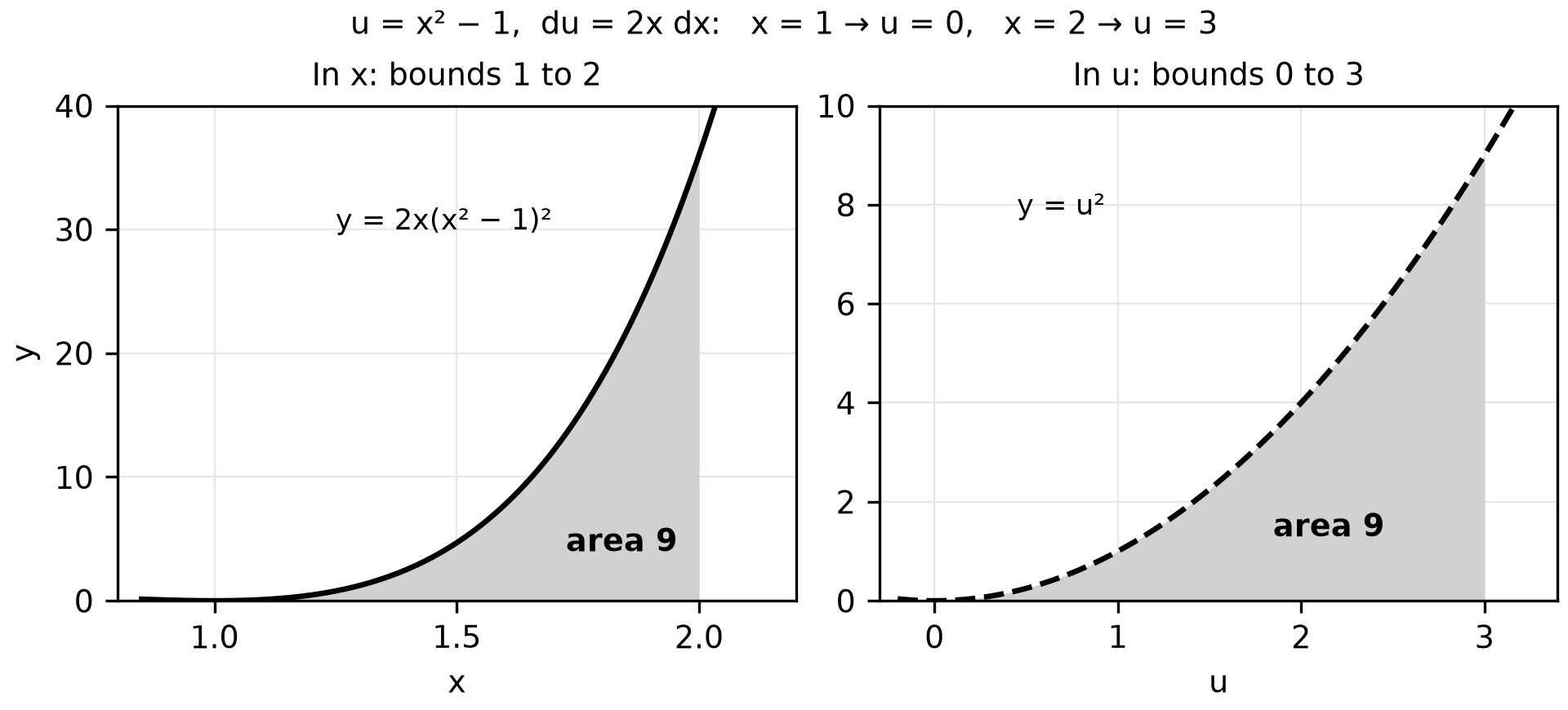
Figure 16.1. Substitution changes the variable, the bounds and the shape, but not the value.
Worked example 16.5: diagnose an incorrect solution
A student evaluates like this: "Let , so the integral is ."
Diagnosis. Two errors. First, the bounds were not converted: and . Second, , so ; the sign was dropped. Correctly,
Check. In : . The integrand is positive on the interval, so a positive value is required.
Try it 16.1. (a) Find . (b) Evaluate . (c) Find .
Answers. (a) . (b) With from 5 to 9: . (c) With and : , so the family is .
Rewrite before integrating (topic 6.10)
When a quotient matches no basic form and no substitution, rewrite it. AB uses two rewrites (CED topic 6.10).
Worked example 16.6: long division
Find .
Solution. The numerator's degree is at least the denominator's, so divide: . For , the integrand equals . The family is on any interval that does not contain 1.
Check. Test the identity at : and . Then differentiate the answer to recover .
Worked example 16.7: divide, then evaluate
Evaluate .
Solution. Since , the integrand is on , where . Then
Check. On the integrand runs from 0 up to , so the value must lie between 0 and . It does.
Completing the square
If the denominator is a quadratic with no real zeros and the numerator is constant, complete the square and use
Both follow from Chapter 15's table with the substitution , and both can be checked by differentiating.
Worked example 16.8: complete the square
Find .
Solution. Half of 4 is 2, and , so . With and , the family is .
Check. The derivative is , the integrand.
The square-root form works the same way: , so on .
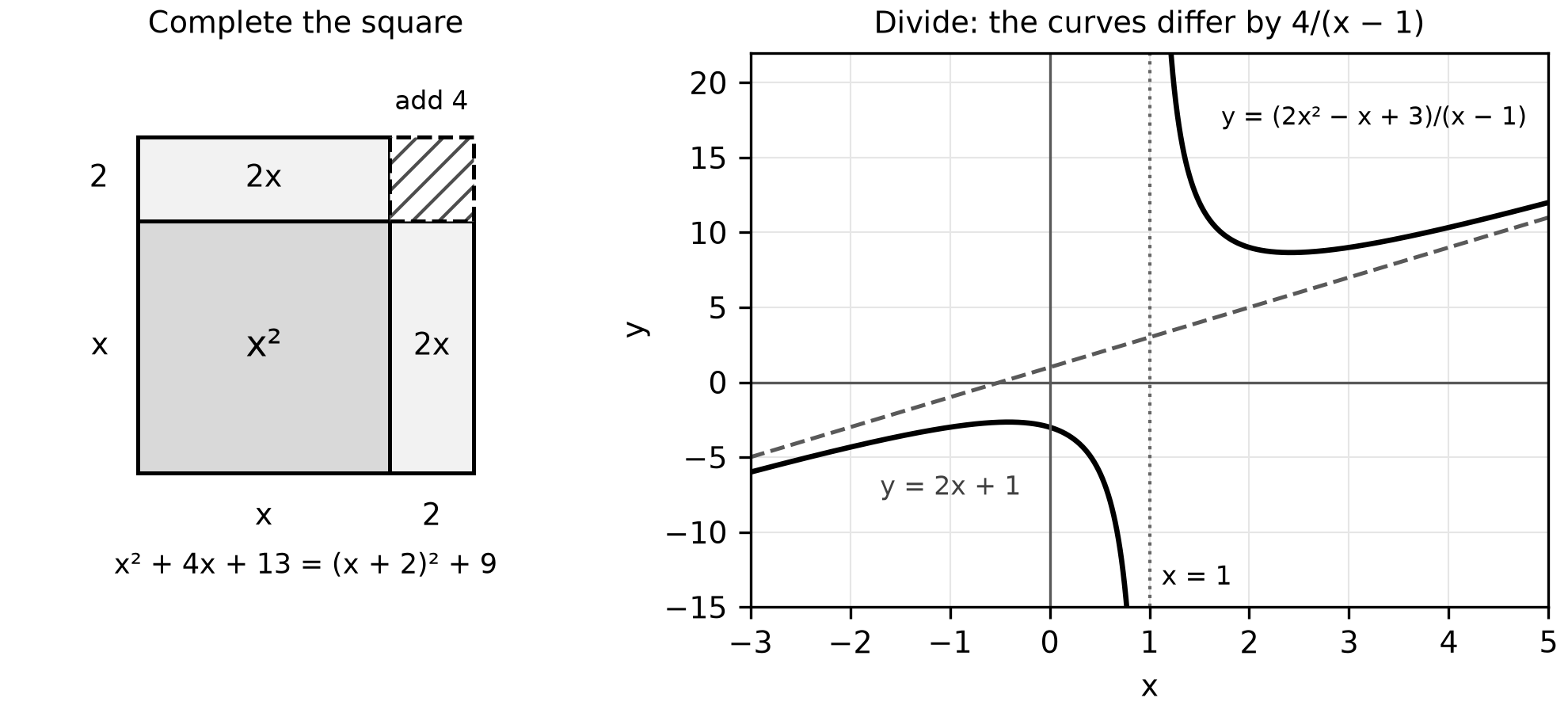
Figure 16.2. Completing the square (left) and long division (right) rewrite an integrand into basic forms.
Common errors. Dropping the factor ; completing the square with the wrong sign, such as for ; writing a logarithm when the numerator is not a multiple of the denominator's derivative.
Try it 16.2. (a) Find . (b) Evaluate . (c) Find .
Answers. (a) Dividing gives , so the family is . (b) gives . (c) integrates to .
Select a method (topic 6.14)
Read the integrand before you write anything, and ask these questions in order.
- Does it match a basic form after simplifying? Use Chapter 15's table.
- Is a composite present with its inner derivative, up to a constant? Substitute.
- Is it a rational function whose numerator's degree is at least the denominator's? Divide.
- Is it a constant over an irreducible quadratic, or over the square root of one? Complete the square.
AB questions are written so that these tools suffice. If a route seems to need integration by parts or partial fractions, look again for a substitution or a rewrite; those methods belong to BC.
Worked example 16.9: four integrals that look alike
(a) . The numerator is half the denominator's derivative, so gives . No absolute value is needed, because .
(b) . No is available to form , so use the arctangent form: .
(c) . The degrees are equal, so divide: , giving .
(d) . The numerator is exactly the derivative of the denominator, so the answer is . Changing the numerator to 1 calls for completing the square instead: .
Check (c). .
Worked example 16.10: substitution with a table
A differentiable function with continuous derivative has , , and (constructed practice data). Find .
Solution. Let , so ; the bounds become 3 and 5. Then .
Check. The table's values are a trap. The integrand is , so the theorem needs values of , the antiderivative.
Try it 16.3. Name the method, then integrate. (a) . (b) . (c) .
Answers. (a) Substitution: . (b) Complete the square: . (c) Divide, then use (b): .
Review and retrieve
Close the book and write the four selection questions with one example of each method. Tomorrow, redo Worked example 16.5 from its statement and name both errors. In a week, return to Worked example 16.9, cover the solutions and justify each choice in one sentence before integrating.
Practice
Chapter 16's practice is items APCAL-C16-M01 to APCAL-C16-M14 and the written task APCAL-C16-F01, printed after this chapter's companion panel as Questions 212–225 and Written task 23. Questions 212–223 and Written task 23 are no-calculator work. Questions 224–225 require a graphing calculator in radian mode; give decimals to the nearest thousandth. Answers, the error behind each wrong choice, the rubric and a complete response are in Answers, explanations and written responses, under Chapter 16: answers and explanations.