What to practice
- Distinguish additive and multiplicative change, discrete indexing and continuous extensions.
Unit 2 begins with a simple question: when the input increases by a fixed step, does the output change by adding the same amount or by multiplying by the same factor? Additive change produces arithmetic sequences and linear functions. Multiplicative change produces geometric sequences and exponential functions. This chapter treats sequences as functions on whole-number inputs (topic 2.1) and then connects them to the linear and exponential functions that extend them to every real input (2.2). Chapter 8 builds on this foundation with the full exponential family.
Quick prerequisite check. What is the slope of the line through and , and what is ? If you answered 3 and 48, you are ready. The first is a rate of change; the second is repeated multiplication.
Sequences are functions on whole-number inputs
A sequence is a function whose inputs are whole-number indices. The notation means the term with index . Two choices must be made explicit: the first index (often 0 or 1) and what each term represents. A sequence's graph is a set of separate points, one per index, because no term exists between index 3 and index 4.
| Type | Constant feature | Explicit rule from a known term | Step-by-step rule |
|---|---|---|---|
| arithmetic | difference | ||
| geometric | ratio , with |
The explicit rules work from any known term, not only the first one, which saves time when a problem gives two terms in the middle of a sequence. Each step of the index adds or multiplies by , so moving from index to index takes steps.
Worked example 7.1: find a sequence from two terms
Arithmetic. An arithmetic sequence has and . Four steps separate the two terms, so and . Then . Check: .
Geometric. A geometric sequence has and . Three steps separate the terms, so and . Then , which gives . The common error is to divide the change by the number of steps, which works only for differences, not ratios.
Worked example 7.2: choose the starting index on purpose
A ball is dropped from a height of 10 m, and each bounce reaches 60% of the previous height. Two correct rules describe the same heights:
- Index from 0, with the drop height: is the height of bounce .
- Index from 1, with the first bounce: .
Both give the height of the fourth bounce as m. Mixing the two, for example writing for bounce , shifts every answer by one bounce. State the index meaning in words before writing the rule.
A negative ratio needs care. The sequence gives : the signs alternate and the absolute values double. It is neither increasing nor decreasing. A ratio between and 0 also alternates, but the terms shrink toward 0.
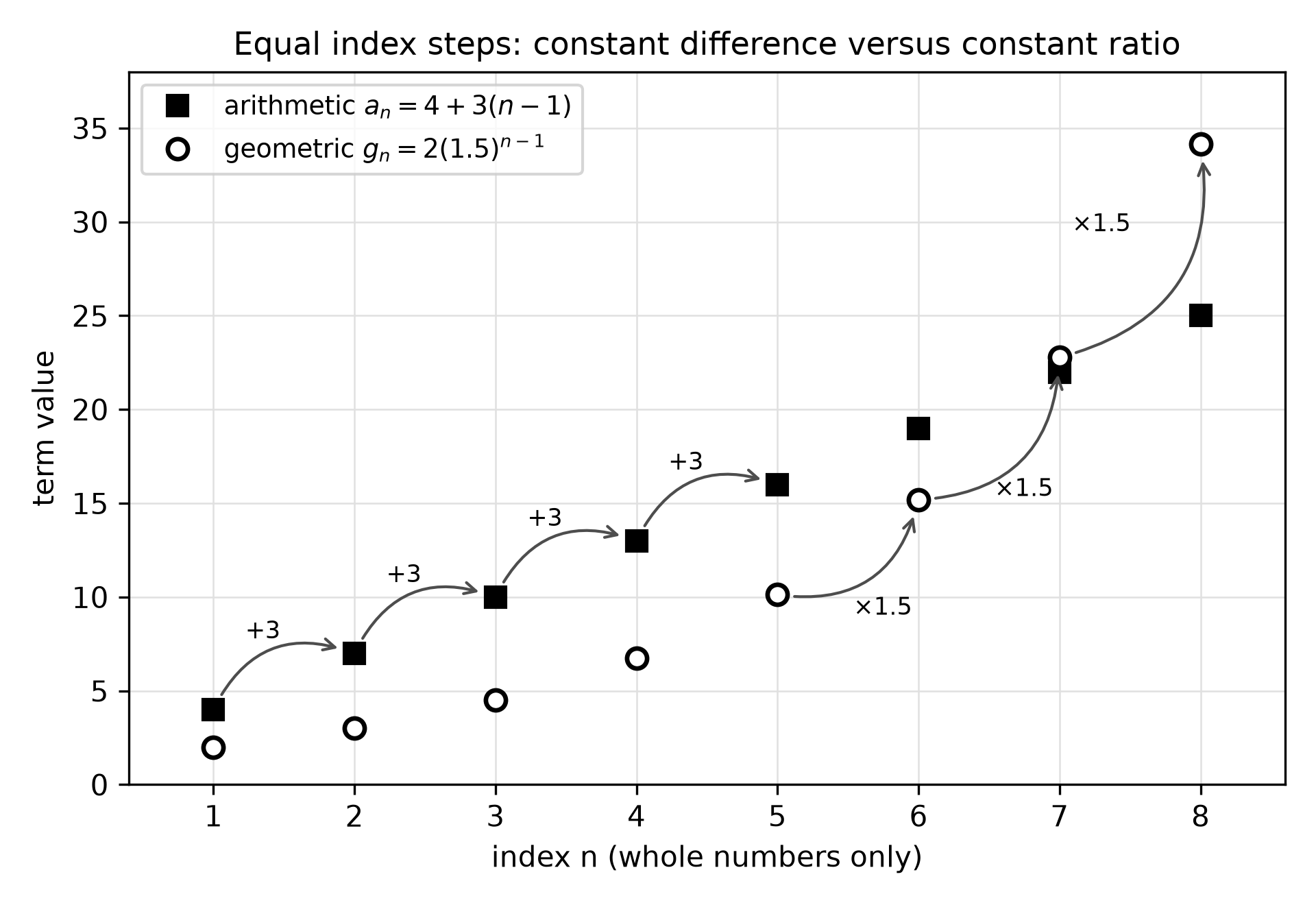
Figure 7.1. Equal index steps produce a constant difference for and a constant ratio for . The points are not joined, because a sequence has no terms between indices.
Errors with sequences
- Starting the exponent at the wrong index, which shifts every term by one step.
- Finding by dividing the change by the number of steps; ratios require a root.
- Calling a sequence with a negative ratio decreasing.
- Drawing a sequence as a continuous curve without saying that this is a modeling choice.
Try it 7.1. A sequence has first term 81 and fourth term 24. Find the sixth term if the sequence is geometric, and again if it is arithmetic.
Check your work. Geometric: , so and the sixth term is . Arithmetic: , so and the sixth term is . The same two terms lead to very different predictions, which is why a model's type must be justified.
Equal input steps reveal additive or multiplicative change
The patterns from sequences carry over to functions on all real inputs. For a linear function , increasing the input by any fixed amount changes the output by the same amount, . For an exponential function with , increasing the input by multiplies the output by the same factor, . Sampled at equally spaced inputs, a linear function produces an arithmetic sequence and an exponential function produces a geometric sequence.
In this sense, linear functions are continuous versions of arithmetic sequences, and exponential functions are continuous versions of geometric sequences. Whether a continuous extension is appropriate depends on the context. Water draining from a tank changes at every instant, so a function of time on an interval is reasonable. Members counted once each week exist only at whole weeks, so the sequence is the honest model, and the curve between the points is a convenience for seeing the trend.
Read the parameters in context
In , is the output when the input is 0, and is the change in output for each 1-unit increase in input, measured in output units per input unit. In , is the output when the input is 0, and is the factor that multiplies the output for each 1-unit increase. A base means growth of percent per unit; a base between 0 and 1 means decay of percent per unit. If a tank holds liters after minutes, it loses 12 liters every minute. If a town's population is after years, it shrinks by 3 percent each year, so it loses fewer people each year as it gets smaller.
Worked example 7.3: classify from an equally spaced table
| 0 | 3 | 6 | 9 | 12 | |
|---|---|---|---|---|---|
| 7 | 13 | 19 | 25 | 31 | |
| 4 | 6 | 9 | 13.5 | 20.25 |
The inputs step by 3. The outputs of change by 6 each time, so is linear with slope and . The outputs of do not change by a constant amount, but each is 1.5 times the previous one, so is exponential with . The factor 1.5 belongs to each 3-unit step; the factor for a 1-unit step is the cube root of 1.5, about 1.145.
Worked example 7.4: unequal spacing hides a linear pattern
| 1 | 2 | 4 | 7 | |
|---|---|---|---|---|
| 10 | 13 | 19 | 28 |
The output changes are 3, 6 and 9, which are not constant. The input changes are 1, 2 and 3, however, so each average rate of change is . The function is consistent with a linear model, . Compare differences or ratios only across equal input steps.
Worked example 7.5: two points, two models
Find a linear function and an exponential function through and , and compare them at .
Linear. The slope is , so and .
Exponential. Two input steps of 1 multiply the output by 9, so and, because an exponential base is positive, . Then gives , so and .
Two points always determine one model of each type, so two points alone never decide which type is correct. Use a third observation or a reason from the context.
Worked example 7.6: when does multiplicative growth overtake additive growth?
In a constructed practice scenario, club A has members in week , and club B has . In week 11, and . In week 12, and . Club B first has more members in week 12, as Figure 7.2 shows. An increasing exponential pattern eventually exceeds any linear pattern, even one with a large head start, because its additions keep growing while the linear additions stay at 500.
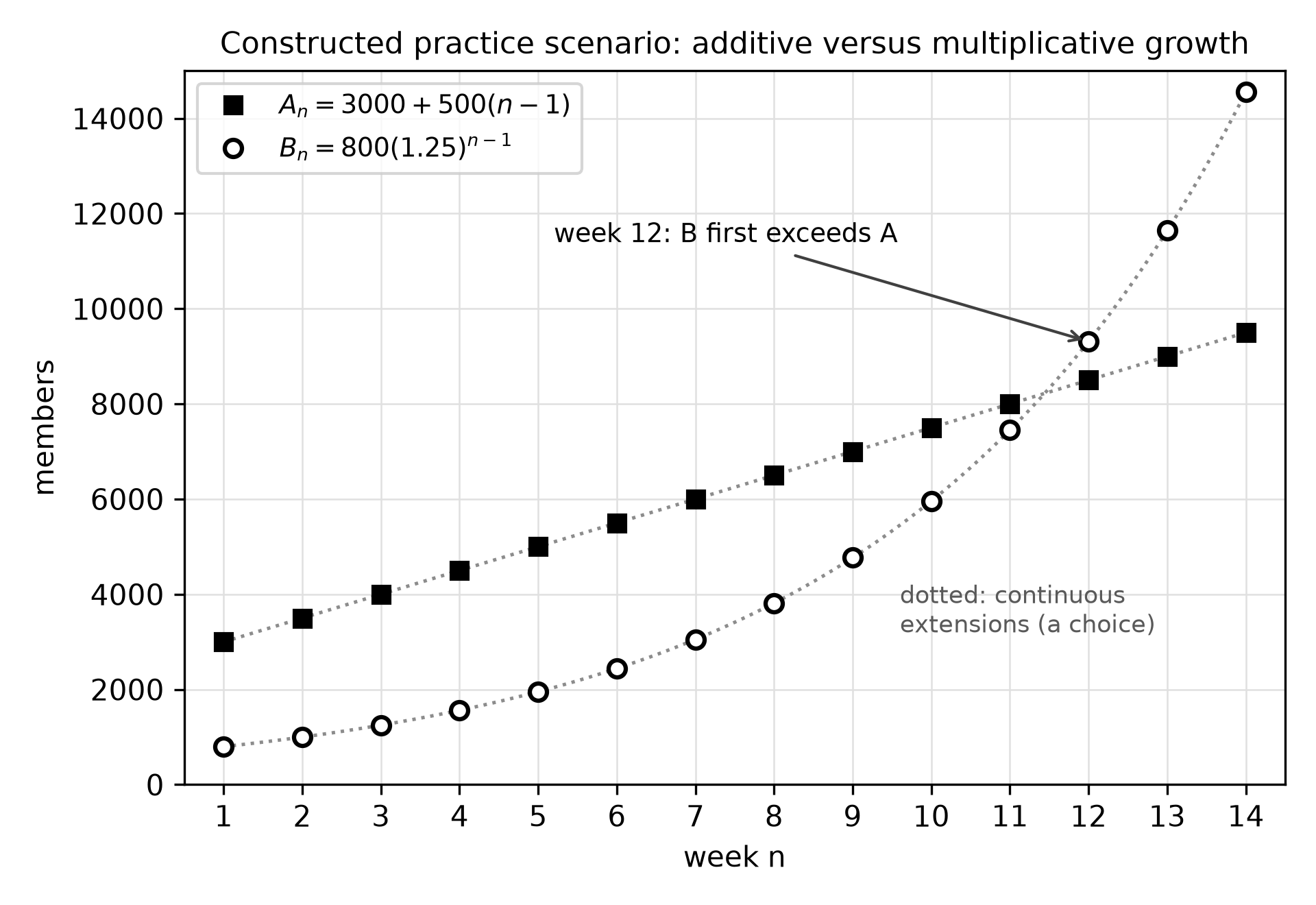
Figure 7.2. Constructed practice data. The markers are the weekly values; the dotted curves are continuous extensions included only to show the trend.
Errors with linear and exponential change
- Applying a per-step factor to a different step length, such as using 1.5 per unit when 1.5 belongs to each 3-unit step.
- Reading unequal input steps as equal ones.
- Treating a percent increase as a fixed amount added each period.
- Reporting a non-whole answer, such as week 11.4, when the sequence exists only at whole indices.
Try it 7.2. For , a function has outputs 40, 30, 22.5 and 16.875. Decide whether it is linear or exponential, write a rule, and predict the output at .
Check your work. The differences are , and , so the function is not linear. Each output is 0.75 times the previous one over each 2-unit step, so it is exponential: . Then .
Common errors to repair
| Error | Repair |
|---|---|
| Dividing a change by the step count to find a ratio | Worked example 7.1 |
| Writing the exponent from the wrong starting index | Worked example 7.2 |
| Applying a per-step factor to a different step length | Worked example 7.3 |
| Comparing differences across unequal input steps | Worked example 7.4 |
| Reporting a non-whole week for a sequence | Worked example 7.6 |
Review and retrieval
Answer from memory first, then check against the chapter.
- Write explicit rules for an arithmetic and a geometric sequence from a known term .
- Explain why a linear function sampled at equal input steps produces an arithmetic sequence.
- Describe how to test a table with unequal input spacing.
- Give one context where a continuous extension is reasonable and one where only the sequence is.
Retry Try it 7.1 at your next session without notes, then rebuild Figure 7.1 from its two rules a few days later. Chapter 8 uses these ideas to build exponential models from data and percent change.
Practice
Twelve multiple-choice questions (Questions 117–128) are printed after this chapter. Questions 117–126 are no-calculator questions; work them by hand. Questions 127 and 128 require a graphing calculator. Keys, complete reasoning for every choice and repair directions are under Chapter 7: answers and explanations in the book's answers section.