What to practice
- Track input compatibility, reverse a process, restrict a domain and verify an inverse.
A heating system reads the air temperature, and a controller turns that reading into a fan speed. No single rule links the room's temperature to the fan, yet the link exists because one function's output became the next function's input. Composition names that chain. An inverse runs it backward: given the fan speed, which reading produced it? This chapter builds, simplifies and decomposes compositions, then reverses functions correctly, including when a domain must first be restricted.
Two habits carry the whole chapter. Read a composition from the inside out, and keep track of which inputs are allowed at every stage.
Composition passes one output forward
The composition of with is written and defined by
Here acts first, and its output becomes the input of : written left to right, worked right to left.
Order matters. Composition is not commutative, so and are usually different functions. With and , you get but . At the first gives 16 and the second gives 4.
The identity function returns every input unchanged, so . It plays the role for composition that 0 plays for addition and 1 plays for multiplication. You will use it to define inverses.
Domain of a composition
An input belongs to the domain of only when it passes two checks:
- is in the domain of , so exists.
- is in the domain of , so can accept it.
For and , every real number passes the first check. The second check fails when , so the domain of is all real numbers except 2. You set 's forbidden input equal to and solved; the excluded number is not 0 itself.
Worked example 10.1: read a composition through a table and a graph
Values of a function can come from any representation. The table gives selected values of , and Figure 10.1 shows the graph of , which consists of line segments.
| −2 | −1 | 0 | 1 | 2 | 3 | |
|---|---|---|---|---|---|---|
| 3 | 1 | −1 | 0 | 4 | 2 |
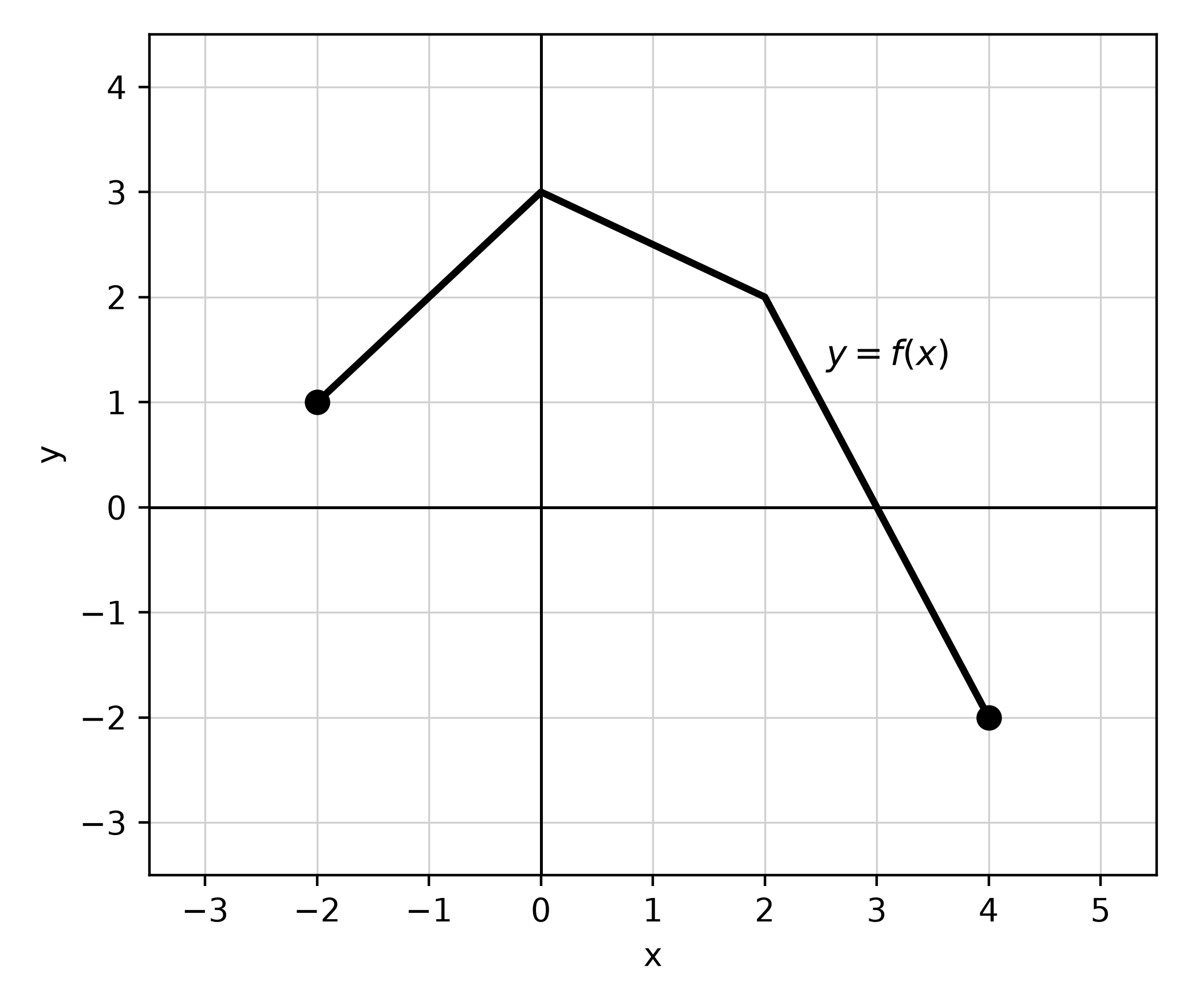
Figure 10.1. A piecewise-linear function defined on . Original graph.
- Find . The table gives . On the graph, . So .
- Find . Now acts first. The segment from to falls 2 units for each unit to the right, so . The table gives , so .
- Try . The segment from to gives . The table has no entry at 2.5 and says nothing about values between its entries, so cannot be determined from the information given.
A table is a list of facts, not permission to interpolate.
Worked example 10.2: a simplified formula can hide a restriction
Let and . Find each composition and its domain.
. Substitute: . The square root needs , and accepts every real output, so the domain is . On that domain, , and
This is not the same function as . Two functions are equal only when they have the same domain and agree at every input in it. The graph of is a ray starting at , not a full line, and is undefined even though .
. Here . Since for every real , this domain is all real numbers. The two compositions have different formulas and different domains.
Worked example 10.3: relate two quantities through a middle quantity
Constructed practice data: a pool is filled for hours, and its water depth is meters. Because the pool's sides slope outward, the volume of water at depth meters is cubic meters. Write volume as a function of time and find the volume after 5 hours.
- Track units. turns hours into meters; turns meters into cubic meters. So turns hours into cubic meters.
- Substitute. for .
- Evaluate. . Check through the chain: and cubic meters.
- State the domain. The composite inherits the time interval, so its largest volume is cubic meters.
Volume and time were never directly related by a given formula, but composition built that relationship through depth.
Take a function apart
Decomposing a function means writing it as . Look for an inner expression that is computed first and then processed as a block. Decompositions are not unique, so choose one that serves the task.
Transformations from Chapter 6 are compositions in disguise. The horizontal shift is with the inner function . The vertical dilation is with the outer function . Changes made to the input are inner functions; changes made to the output are outer functions.
Worked example 10.4: two decompositions of one function
Write as a composition in two different ways.
- Decomposition 1. Inner , outer . Check: . This version shows as a transformation of : the inner function changes the input, and shifts the output.
- Decomposition 2. Inner , outer . The check gives the same .
An outer identity function always gives a decomposition, but a useless one; a useful decomposition splits the work into meaningful stages.
An inverse reverses the mapping
A function is one-to-one when every output comes from exactly one input. A one-to-one function has an inverse function that undoes it:
The notation is not an exponent. In general .
Inverses come with four linked facts.
- Identity. for every in the domain of , and for every in the domain of .
- Swapped sets. The domain of is the range of , and the range of is the domain of .
- Reflected graph. The point is on the graph of exactly when is on the graph of , so the graphs are reflections over the line .
- Swapped variables. To find a formula, write , exchange and , and solve for .
Read an inverse from pairs, tables and graphs
For a table, exchange the input and output rows; the new table describes only if no output was repeated. For a graph, is the -coordinate of the point where the horizontal line meets the graph. If some horizontal line meets the graph twice, is not one-to-one on that domain. A function that is always increasing or always decreasing on its domain passes this test automatically.
Worked example 10.5: reverse the operations of a rational function
Find the inverse of , .
- Swap. Write .
- Clear the fraction. , so .
- Collect the -terms. , so .
- Solve. , with .
The restriction is meaningful. As grows, approaches 1 but never equals it, so 1 is not in the range of ; therefore 1 cannot be in the domain of . Check one pair: , and .
Restrict a domain to make an inverse
A function that repeats outputs has no inverse on its full domain. Restrict it to an interval on which it is always increasing or always decreasing, and the restricted function is invertible.
Worked example 10.6: choose a branch of a quadratic
Let . Since , is not one-to-one. Its vertex is , so restrict to , where is increasing. The restricted range is .
- Swap. .
- Isolate the square. , so .
- Choose the sign. The inverse's outputs are the original inputs, which satisfy . Keep the positive root.
Figure 10.2 shows both curves. If you had chosen the branch instead, the inverse would be for .
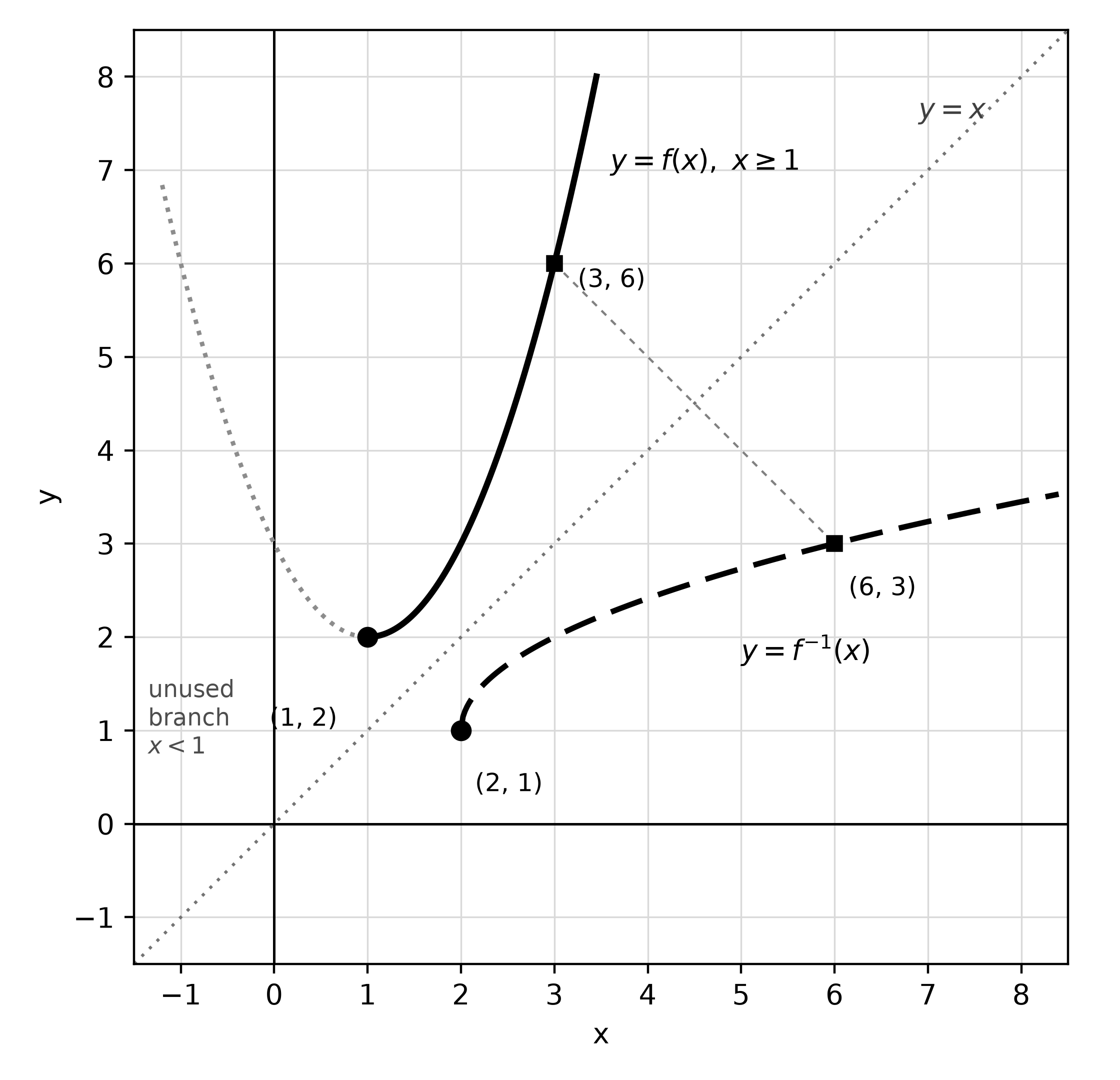
Figure 10.2. A restricted quadratic and its inverse are reflections over ; the pair and shows the exchange. Original graph.
What goes wrong without the restriction? , but , not . The formula returns the right-branch input that also produces 6.
Verify an inverse in both orders
Compose in both directions and watch the domains.
- for .
- , which equals only when .
The absolute value is where the restriction does its work. Without , the second composition is not the identity.
Contexts can restrict an inverse further
The conversion turns degrees Celsius into degrees Fahrenheit, and its inverse turns them back. Mathematically both accept every real number, but no temperature is below absolute zero, °C. The context therefore restricts the inverse's domain to . In context, an inverse's input and output units swap.
Common errors to repair
- Working left to right. In , evaluate the inner function first.
- Reading the inverse as a reciprocal. asks which input gives 5; it is not .
- Simplifying away a restriction. Record the domain before you simplify, as in Worked example 10.2.
- Keeping both signs. After taking a square root, choose the sign that matches the restricted domain.
- Assuming order does not matter. Test one input in both and .
An explained incorrect solution. A student is asked for the domain of , where and , and writes: ". Since cannot accept 4, the domain is ." The formula is right, but the reasoning applied 's restriction to instead of to . The excluded inputs are those with , that is, . The correct domain is all real numbers except and . At , the composite is , so 4 belongs in the domain after all.
Try it
10.1 (guided). Use the table and Figure 10.1 from Worked example 10.1. (a) : from the graph, ; then ____. (b) Find . (c) Find .
10.2. Let and . Find the domain of .
10.3. Find the inverse of , , and state its domain.
10.4. Let for . Find and its domain, evaluate , and verify that .
Check your try-it work
10.1. (a) and , so . (b) and , so . (c) , and the segment from to gives , so . Here the graph supplies the in-between value; in Worked example 10.1 the table could not.
10.2. Every real number is allowed in . The square root needs , so , which gives . Students who solve have applied the restriction to instead of to .
10.3. Swap to get . Then , so and with . As a check, and .
10.4. On , is decreasing with range . Swap: , so . The inverse's outputs must be at least 0, so for . Then and .
Retrieve and review
Without the book, write the two domain checks for and the four facts that link and , then sketch Figure 10.2 and mark one exchanged pair. At your next session, redo Worked example 10.6 with the branch and verify the inverse in both orders. A week later, decompose in two ways and say which shows a transformation of . Chapter 11 applies these ideas to exponential and logarithmic functions, and Chapter 15 restricts trigonometric functions to define their inverses.
Practice
Attempt the printed Chapter 10 practice set before reading any solution. It contains twelve multiple-choice questions, Questions 155–166, followed by Written tasks 9–10.
- No calculator: Questions 155–163. Show the inner value before the outer one, and state domains exactly.
- Graphing calculator required: Questions 164–166 and both written tasks. Report decimal answers correct to three places unless a question says otherwise.
Allow about 25 minutes for the multiple-choice questions and about 16 minutes for each written task. Then check your work in "Chapter 10: answers and explanations" in the answer section. For each miss, use the repair note printed with the explanation and return to the named heading before trying a fresh question.