What to practice
- Connect logarithms with inverse exponentials, graphs, equivalent forms and valid domains.
An exponential function answers a forward question: start with a base, apply it times, and what do you get? Many problems ask the reverse. How many doublings turn 1 gram into 1,000 grams? Which power of 10 is 31.6? A logarithm is the name for that unknown exponent. Because Chapter 10 showed how inverses reverse a mapping, you already know the logic: a logarithmic function is the inverse of an exponential function, and every property in this chapter is an exponent property seen from the other side.
Keep one sentence in mind: a logarithm is an exponent. When an expression looks unfamiliar, translate it into a statement about a power.
A logarithm names an exponent
Let with , and let . Then
Read as "the exponent you put on to get ." The base is written as a subscript. Two bases have special notation. When no base is written, the base is 10, so . The natural logarithm means , where .
The restrictions are not arbitrary. Every power of a positive base is positive, so no exponent produces 0 or a negative number; is undefined. A base of 1 is excluded because every power of 1 equals 1.
Some logarithms can be found exactly by arithmetic, when is a recognizable power of . Others can only be estimated between integers or approximated with technology.
Worked example 11.1: evaluate by matching powers
Evaluate without a calculator.
- . Write both numbers as powers of 3. If , then , so and . Check: .
- . Since , the value is . A logarithm can be negative; its argument cannot.
- . The base is 10, and , so the value is .
- . The exponent on is 4, so .
The common wrong answer to the first part is . That divides the numbers instead of finding an exponent, and shows it fails.
Worked example 11.2: estimate between integers
Estimate and .
- . Bracket 300 between powers of 5: and . Since , the logarithm is between 3 and 4. To refine, find the exponent 3.5: . Since 300 is larger, the logarithm is a little more than 3.5. A calculator gives .
- . Now the argument is less than 1, so the exponent is negative. Since and , and , the logarithm is between and . A calculator gives about .
Bracketing first protects you from calculator slips. If a calculator returned 1.661 for the second value, the missing sign would be obvious.
Read a logarithmic scale
On an ordinary number line, equal distances represent equal differences. On a logarithmic scale, equal distances represent equal factors. On a base-10 scale, the position is labeled , so moving one unit to the right multiplies the value by 10. The units of a logarithmic scale are multiplicative.
This makes logarithmic scales useful for values that range over several powers of 10. In Figure 11.1, the numbers 1, 10 and 100 are crowded together on a linear scale but evenly spaced on a logarithmic one.
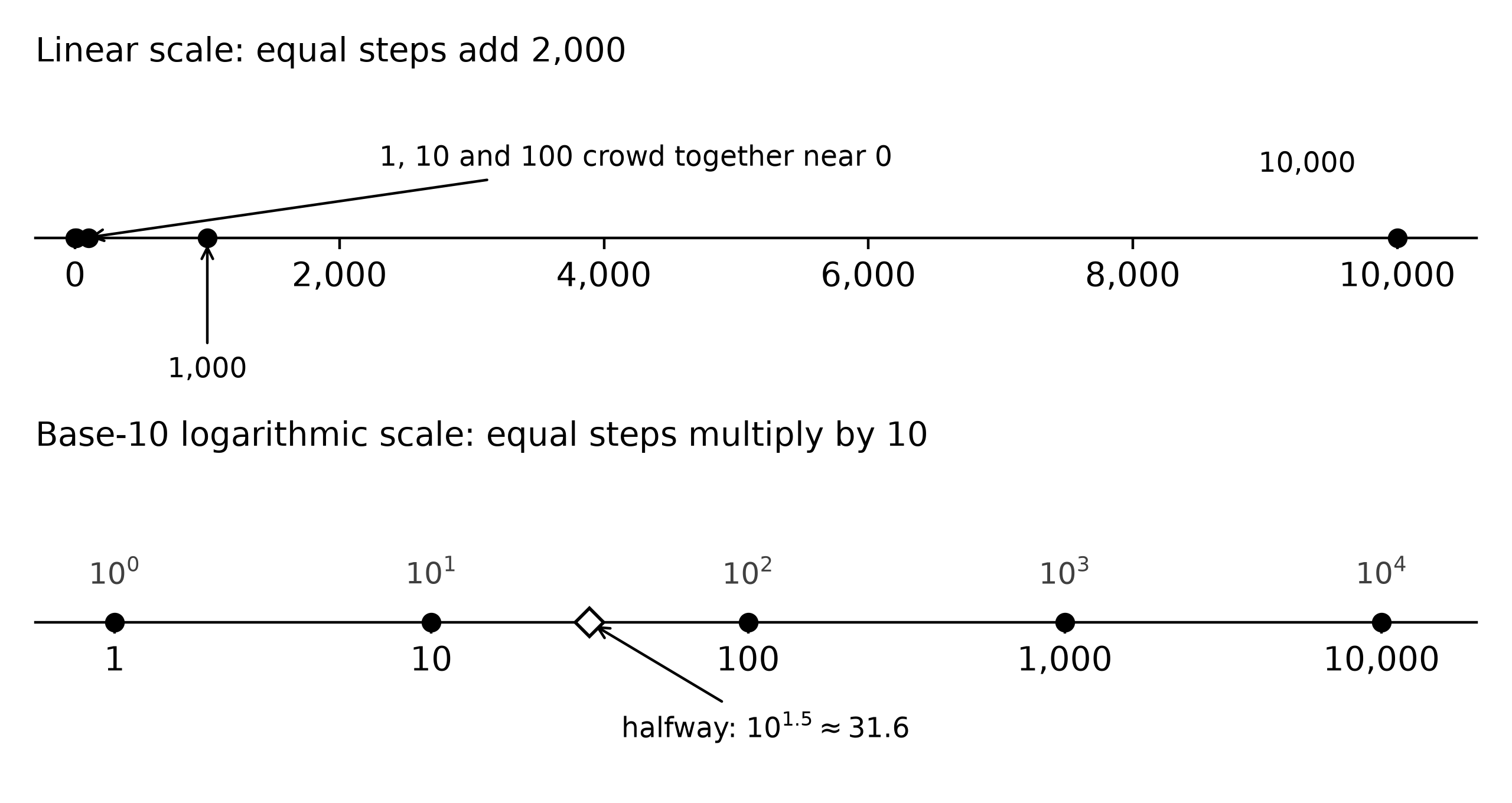
Figure 11.1. The same five numbers on a linear scale and on a base-10 logarithmic scale. Original diagram.
The point halfway between 10 and 100 on the logarithmic scale sits at position 1.5, so it represents , not the arithmetic midpoint 55. To read any point, find its position and raise the base to that power. A point three-tenths of the way from 100 to 1,000 is at position 2.3 and represents . Reading it as treats the scale as linear between the labels, which it is not.
Logarithms undo exponentials
For a base with , the functions and are inverses:
So and , with no calculation: each function undoes the other. All the inverse facts from Chapter 10 apply. If is on the graph of , then is on the graph of . The domain of is , the range of ; the range of is all real numbers, the domain of . The graphs are reflections over , as Figure 11.2 shows for base 2.
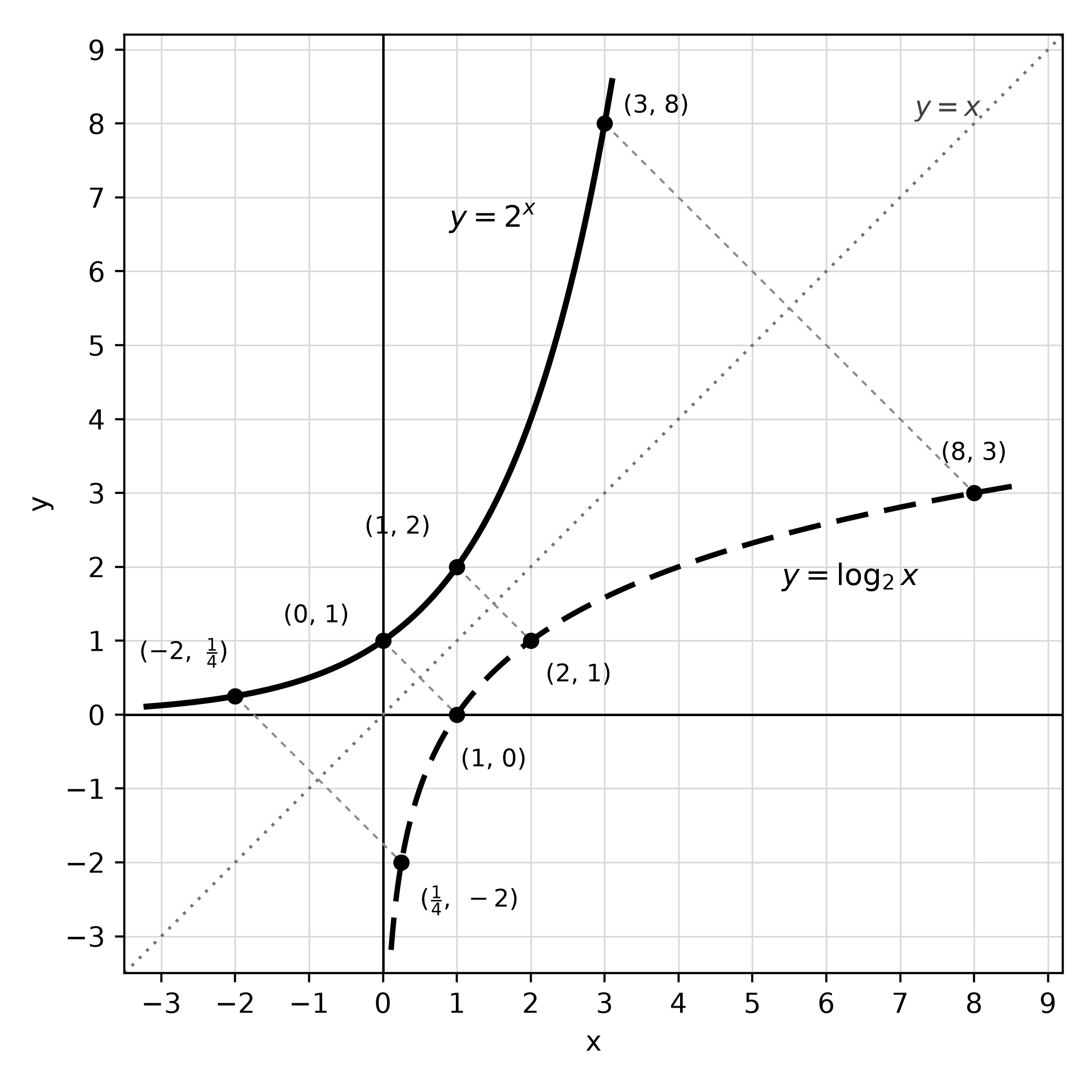
Figure 11.2. An exponential function and its inverse logarithmic function, with four exchanged pairs. Original graph.
The two functions turn change patterns inside out. For an exponential function, adding a constant to the input multiplies the output by a constant. For a logarithmic function, multiplying the input by a constant adds a constant to the output. On the dashed curve in Figure 11.2, each doubling of the input, from 1 to 2 to 4 to 8, raises the output by exactly 1.
A logarithmic function in general form is , with , and .
Worked example 11.3: build an inverse table for
Start with values of , then exchange the rows.
| −1 | 0 | 1 | 2 | ||
|---|---|---|---|---|---|
| 1 | 2 | 4 | 16 |
The exchanged table gives , , , and . The entry is easy to miss until you read it as "4 to what power is 2?"
Worked example 11.4: recognize a logarithmic pattern in data
Constructed practice data: takes the values 1, 4, 16 and 64, and takes the values 5, 8, 11 and 14. Find a model.
- Test the inputs. Each input is 4 times the previous one, so the inputs change by a constant factor.
- Test the outputs. Each output is 3 more than the previous one, so the outputs change by a constant difference.
- Name the pattern. Multiplied inputs paired with added outputs is the logarithmic pattern.
- Build the rule. Each factor of 4 adds 3, and when , where . So .
- Check. At , and .
If the roles were reversed, with inputs rising by equal differences and outputs multiplied, the pattern would be exponential.
Read the graph of a logarithmic function
The graph of has a fixed set of features.
- Domain and range. The domain is , and the range is all real numbers.
- Monotonicity and concavity. The function is always increasing or always decreasing, and its graph is always concave down or always concave up, so it has no point of inflection. The table shows which case applies.
- Extrema. On its whole domain there is no maximum or minimum. On a closed interval inside the domain, the extremes occur at the endpoints.
- Asymptote and end behavior. The line is a vertical asymptote. Near it the outputs are unbounded; as increases without bound, the outputs are also unbounded, though they change slowly.
| Sign of | Base | Behavior | Concavity |
|---|---|---|---|
| increasing | concave down | ||
| decreasing | concave up | ||
| decreasing | concave up | ||
| increasing | concave down |
Compare this table with the one for exponential functions in Chapter 8. Reflecting over keeps an increasing function increasing but flips its concavity, which is why is concave up and is concave down.
An additive transformation moves these features. For , the domain is and the vertical asymptote is . The multiply-then-add pattern now belongs to , not to : proportional values of itself no longer give equal output changes.
Worked example 11.5: features of a shifted, reflected logarithm
Describe , shown in Figure 11.3.
- Domain and asymptote. The argument must be positive, so and the domain is . The vertical asymptote is .
- Direction and concavity. increases and is concave down. Multiplying it by makes decreasing and concave up.
- End behavior. As approaches from the right, decreases without bound, so increases without bound. As increases, decreases without bound.
- Intercepts. Setting gives , so and . The -intercept is .
- Pattern check. The marked inputs make equal to 0.5, 1, 2, 4, 8 and 16. Each doubling lowers by exactly 1.
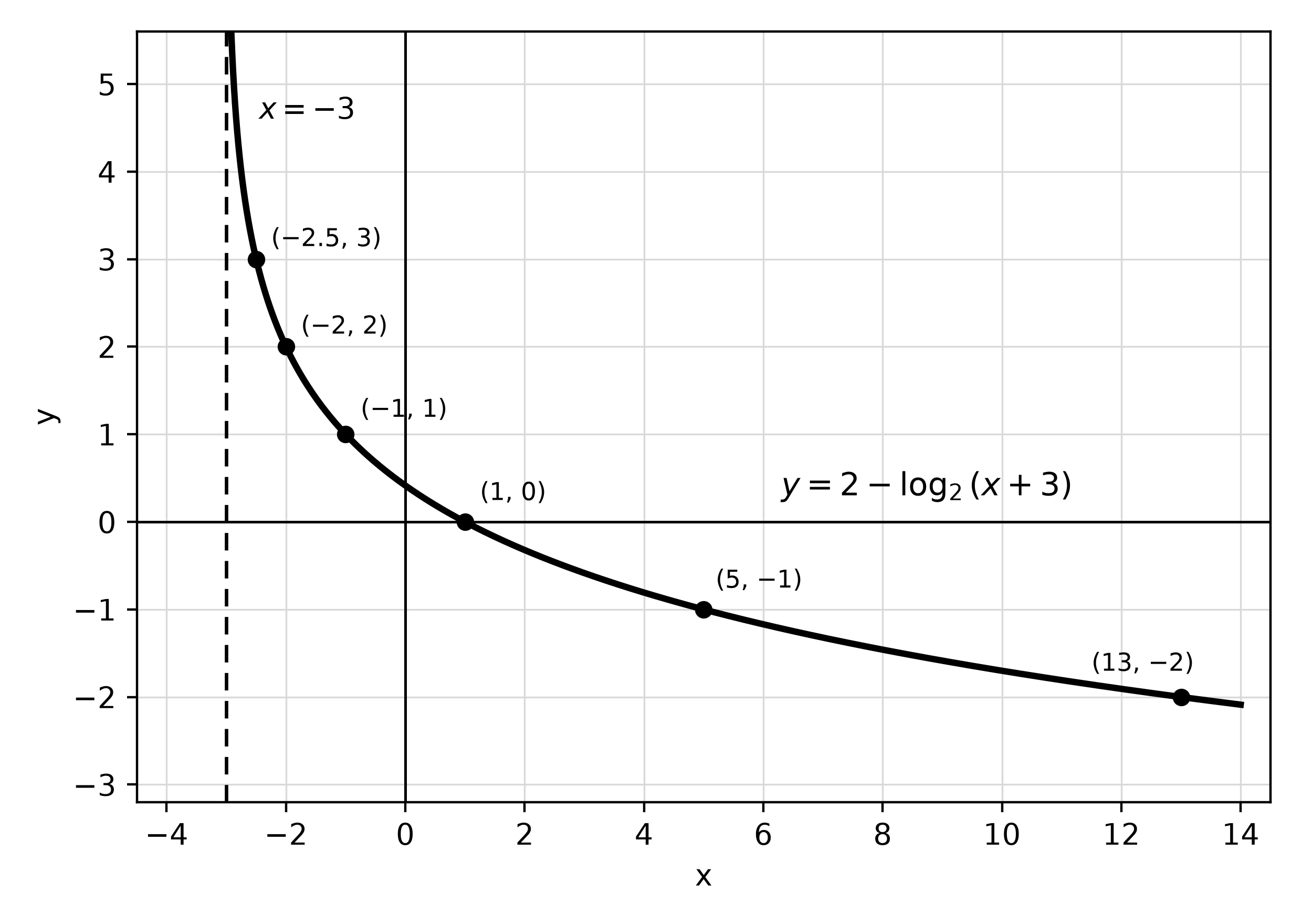
Figure 11.3. A reflected and shifted logarithmic function with its vertical asymptote. Original graph.
Because the domain is an open interval, has no maximum or minimum. Restricted to , it has maximum and minimum , both at endpoints.
Rewrite logarithmic expressions
For , and positive inputs and , four properties hold.
| Property | Statement |
|---|---|
| Product | |
| Quotient | |
| Power | |
| Change of base | for any valid base |
Each property is an exponent rule in disguise. Let and , so and . Then , and the definition gives .
Each property also describes a graph.
- The product property says . A horizontal dilation of a logarithmic graph is the same as a vertical translation.
- The power property says raising the input to a power multiplies the output, so is a vertical dilation of for .
- Change of base says . Every logarithmic function is a vertical dilation of every other, which is also why a calculator with only and keys can evaluate any base.
Worked example 11.6: rewrite for a purpose
- Show that is a vertical translation of . By the product property, . Compressing horizontally by a factor of has the same effect as shifting up 2.
- Write as a multiple of . By change of base, , a vertical dilation by a factor of .
- Expand for . The product and power properties give .
Worked example 11.7: condense, then check the domain
Write as a single logarithm for .
- Power first. .
- Combine. .
- Compare domains. The original requires . The condensed form only requires , which also allows . The two expressions agree only for , so the restriction must be stated.
The same caution applies to and . The first is defined only for . The second is defined for or . Rewriting with the properties never removes the original domain's restrictions.
Common errors to repair
- Splitting a sum. is not . The product property needs a product.
- Confusing a quotient of logarithms with the logarithm of a quotient. is a change of base, , not .
- Squaring the logarithm. is not . The power property moves the exponent of the argument.
- Dropping the domain. and agree only for .
- Reading a logarithmic scale linearly. Halfway between 10 and 100 is about 31.6, not 55.
An explained incorrect solution. A student writes: "The graph of is the graph of stretched vertically by a factor of 8." The 8 multiplies the input, not the output, so it cannot be a vertical stretch. By the product property, , a vertical shift up 3, equivalently a horizontal compression by a factor of . A quick check exposes the error: at , the student's graph gives , but .
Try it
11.1 (guided). Evaluate . If , then equals 3 raised to the power ____, so ____.
11.2. Let . Find , state the domain and vertical asymptote, and find the exact -intercept.
11.3. For , write in the form .
11.4. A classmate writes, "." Explain the error, give a valid rewrite, and show without a calculator that .
Check your try-it work
11.1. , so and . Check: .
11.2. . The domain is , and the asymptote is . Setting gives , so .
11.3. .
11.4. The product property applies to products, not sums. A valid rewrite is . Since , ; a calculator gives about 1.301.
Retrieve and review
Without the book, write the definition of with its restrictions, the four properties and the graph meaning of each. Sketch and with two exchanged pairs. At your next session, redo Worked example 11.5 for and compare every feature. A week later, explain in two sentences why is a vertical translation. Chapter 12 uses these properties to solve exponential and logarithmic equations and to read semi-log plots of data.
Practice
Attempt the printed Chapter 11 practice set before reading any solution. It contains fourteen multiple-choice questions, Questions 167–180, followed by Written tasks 11–12.
- No calculator: Questions 167–177 and both written tasks. Give exact values and state every domain restriction you rely on.
- Graphing calculator required: Questions 178–180. Report decimal answers to the precision each question names.
Allow about 30 minutes for the multiple-choice questions and about 16 minutes for each written task. Then check your work in "Chapter 11: answers and explanations" in the answer section. For each miss, use the repair note printed with the explanation and return to the named heading before trying a fresh question.