What to practice
- Develop radians, exact values, circular coordinates and sine/cosine graph behavior.
Unit 3 studies functions whose outputs repeat. A seat on a turning wheel, a tide gauge and a pump on a timer all return to earlier states on a schedule. This chapter builds the tools for describing that repetition: the period of a relationship, radian measure, the sine, cosine and tangent of an angle, exact circular values and the graphs of sine and cosine. It covers topics 3.1 to 3.4 of the AP Precalculus Course and Exam Description. Calculator questions on the exam use radian mode, so set your calculator to radians before you start the practice.
Recognize a periodic relationship
A relationship is periodic when, as the inputs increase, the outputs repeat a pattern over successive intervals of equal length. The period is the smallest positive number for which for every in the domain. Because of that definition, any one interval of width determines the whole function. Intervals of increase and decrease, changes in concavity and average rates of change found in one period reappear in every period.
To find a period from a description, a graph or a table, look for the place where the whole pattern begins again: the same output, moving in the same direction, followed by the same sequence of later outputs. Equal outputs alone are not enough.
Worked example 13.1: from a verbal description to one cycle
This is a constructed description. A timed irrigation tank fills at a constant rate from a water level of 2 meters to 5 meters over 6 minutes. The level then stays at 5 meters for 1 minute and drains at a constant rate back to 2 meters over 3 minutes. The cycle repeats.
One cycle. On , the level rises at 0.5 meter per minute until , stays constant until and falls at 1 meter per minute until . The period is the total time of the three stages, 10 minutes.
Use the period. Since , . At the tank has been draining for 1 minute, so meters. The rates repeat too: the level falls at 1 meter per minute on every interval from to , where is a whole number.
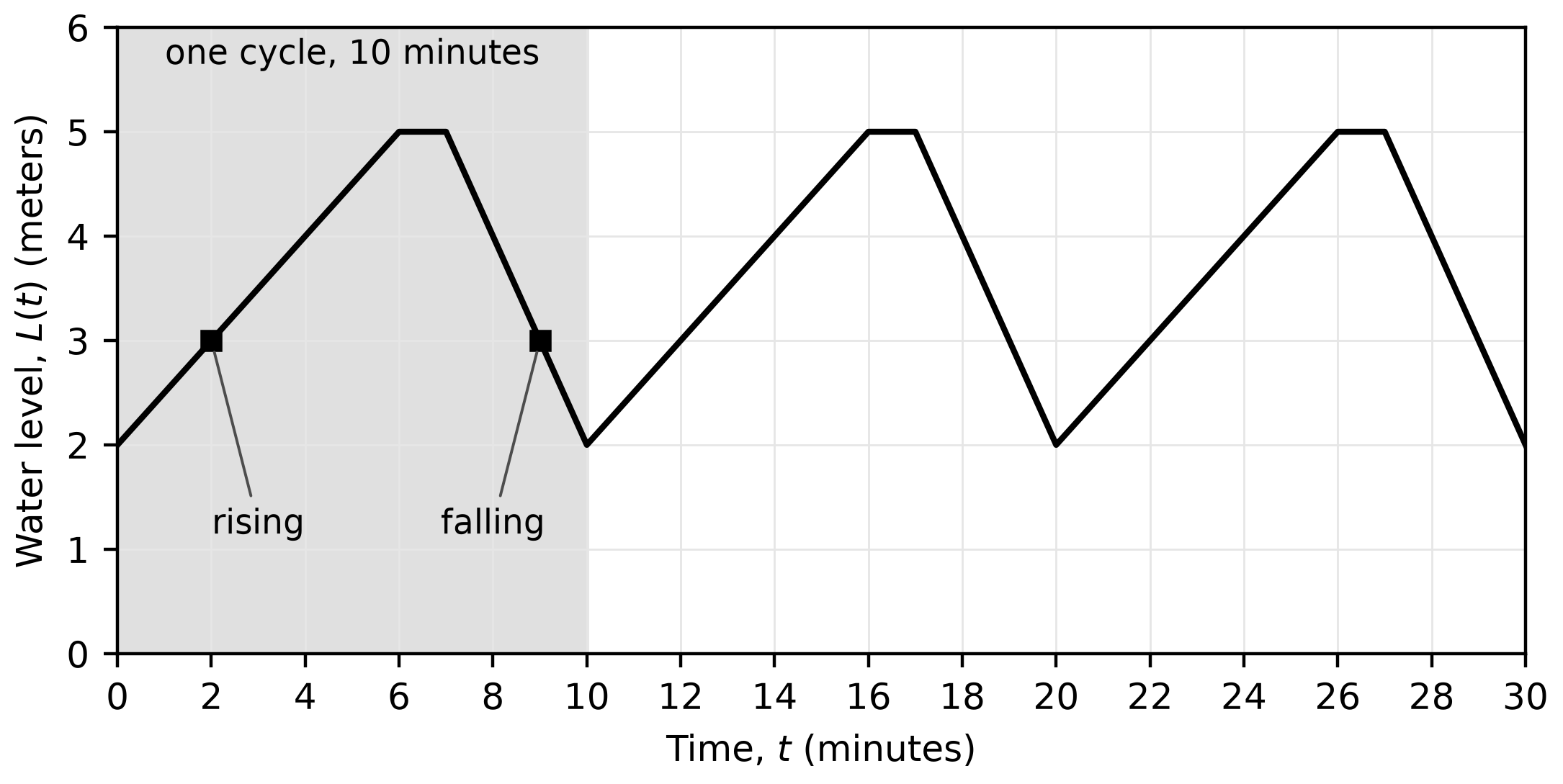
Figure 13.1. Three cycles of the constructed tank level. The level is 3 meters at and at , but 7 minutes is not the period: the level is rising at one time and falling at the other.
Worked example 13.2: test a proposed period against data
A sensor reports constructed values at equally spaced times.
| 0 | 1 | 2 | 3 | 4 | 5 | 6 | 7 | 8 | |
|---|---|---|---|---|---|---|---|---|---|
| 1 | 3 | 4 | 3 | 1 | 3 | 4 | 3 | 1 |
A student claims the period is 2 because . Test the claim with the definition: if the period were 2, then would equal , but . The reading is rising at and falling at . Every listed pair four units apart matches, so 4 is consistent with the data. A table cannot show what happens between listed times, so a description of the process is still needed to confirm the period.
Measure angles in radians
An angle is in standard position when its vertex is at the origin and one ray lies along the positive -axis. The other ray is the terminal ray. Positive measures rotate counterclockwise and negative measures rotate clockwise. Angles that share a terminal ray differ by a whole number of revolutions; they are coterminal.
For a circle centered at the vertex, the radian measure of an angle is the length of the arc it cuts off divided by the radius:
On the unit circle, one radian is the angle cut off by an arc of length 1, as panel A of Figure 13.2 shows. Because and are both lengths, the ratio does not depend on the size of the circle: the same angle cuts off an arc five times as long on a circle five times as large. A full revolution cuts off the whole circumference, so it measures radians. Therefore corresponds to and to .
Worked example 13.3: an arc becomes an angle
A runner on a circular track of radius 40 meters starts at the point due east of the center and runs 100 meters counterclockwise. The angle is radians, a ratio of two lengths with no unit attached. To locate the runner, compare with and : since , the terminal ray lies in Quadrant II. As a check, . The measure is 2.5, not ; appears only when an arc is a multiple of half the circumference. After one more lap the angle is radians, coterminal with 2.5.
Try it 13.1. A wheel of radius 0.3 meter rolls 1.5 meters without slipping, so a point on its rim travels an arc of 1.5 meters. Through what angle does the wheel turn? Through what angle would a wheel of radius 0.6 meter turn over the same distance?
Check your work. radians for the smaller wheel and radians for the larger one. For a fixed arc, doubling the radius halves the angle.
Sine, cosine and tangent from a terminal ray
Let the terminal ray of meet a circle of radius centered at the origin at . Then
The sine is the vertical displacement of from the -axis divided by its distance from the origin; the cosine is the horizontal displacement from the -axis divided by the same distance. The tangent is the slope of the terminal ray, so it is undefined when the ray is vertical and . On the unit circle, and . Tangent is a ratio, not a third coordinate. Derive signs from the coordinates of instead of a memorized phrase: in Quadrant II, for example, and , so the sine is positive while the cosine and tangent are negative.
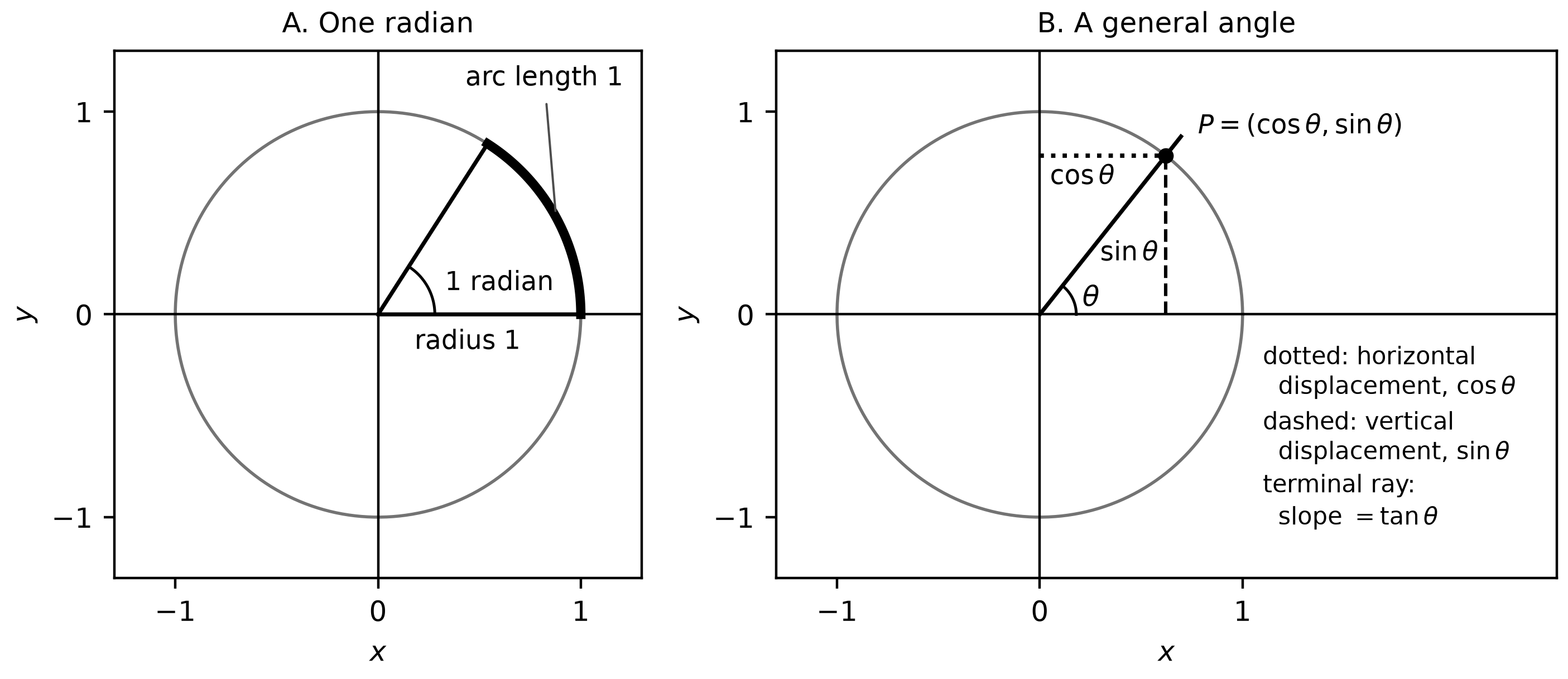
Figure 13.2. Radian measure as a ratio of arc length to radius, and the coordinates and slope that define cosine, sine and tangent.
Worked example 13.4: values from any point on the ray
The terminal ray of passes through . That point lies on a circle of radius . So , and . Check: , so lies on the unit circle, as it must. The point on the same ray gives the same three ratios. The coordinates 12 and are not themselves the sine and cosine, because this circle's radius is not 1.
Exact values from special triangles
Two triangles supply exact values. An isosceles right triangle with hypotenuse 1 has legs , giving . Half of an equilateral triangle with side 1 has hypotenuse 1, a short leg opposite the angle and a long leg opposite .
| Angle | |||
|---|---|---|---|
For other multiples of and , use the reference angle, the acute angle between the terminal ray and the -axis. The reference angle supplies the sizes of the coordinates; the quadrant supplies their signs. On a circle of radius centered at the origin, the point on the terminal ray is .
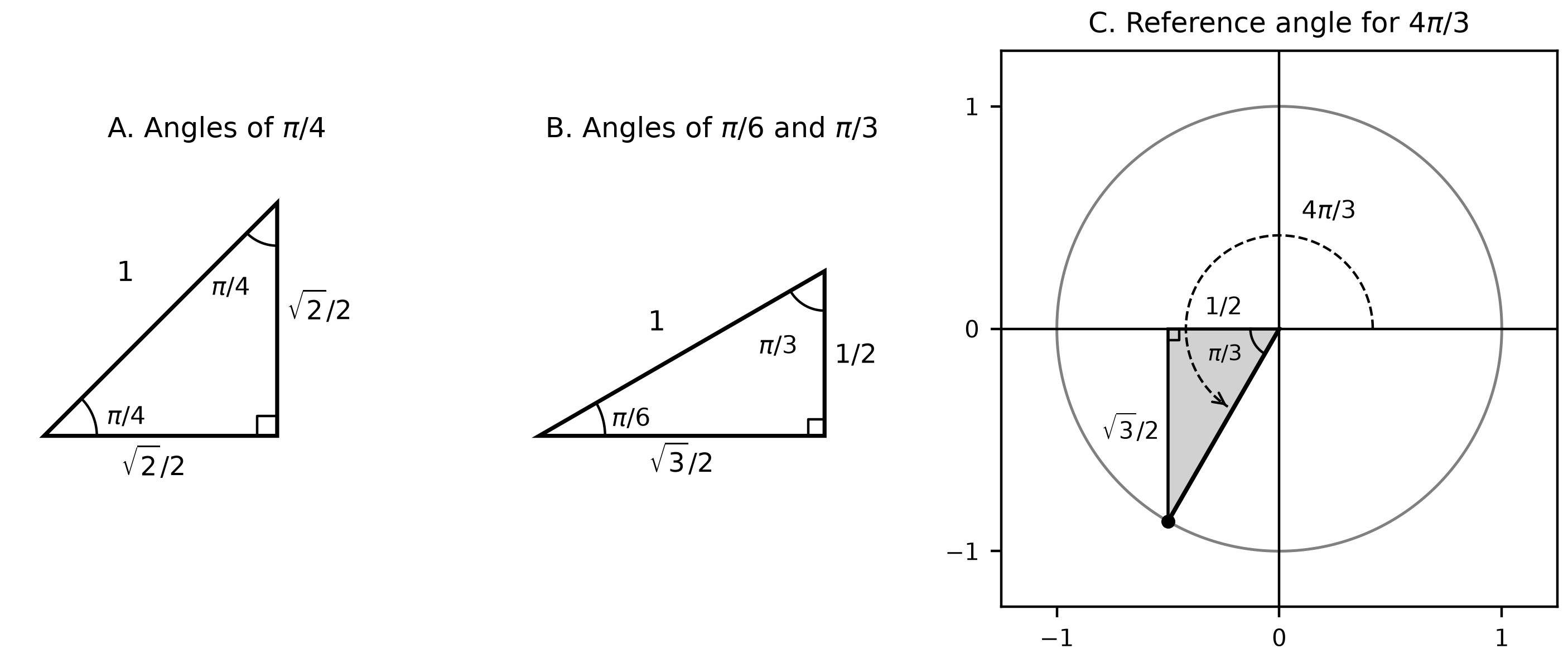
Figure 13.3. The two special triangles and a reference triangle in Quadrant III. Signs come from the direction of each leg, not from the triangle.
Worked example 13.5: reference angle plus quadrant
(a) is one third of past the negative -axis, so it lies in Quadrant III with reference angle . Both coordinates are negative: .
(b) rotates clockwise into Quadrant IV, so the point is .
(c) On a circle of radius 6, lies in Quadrant II with reference angle . The point is . Check: .
A common error in (a) is writing from the reference triangle alone. The leg points left of the origin, so the cosine is negative.
Try it 13.2 (partly done). On a circle of radius 10 centered at the origin, . Its terminal ray lies in Quadrant IV with reference angle . Find the coordinates of the point on the ray.
Check your work. In Quadrant IV, and , so the point is .
Try it 13.3. Without a calculator, find , and name every angle in at which the tangent is undefined.
Check your work. . The tangent is undefined where the terminal ray is vertical: and .
Build the sine and cosine graphs from the circle
The sine function takes an angle as its input and gives the vertical displacement of from the -axis on the unit circle. The cosine function gives the horizontal displacement of from the -axis. Both have all real numbers as their domain. As the angle increases, each output oscillates between and 1 and takes every value in between. Each added returns to the same point, so both functions repeat every ; Chapter 14 adds amplitude, midline and other parameters. Displacement is signed: below the -axis the sine is negative, while the distance from the axis would be .
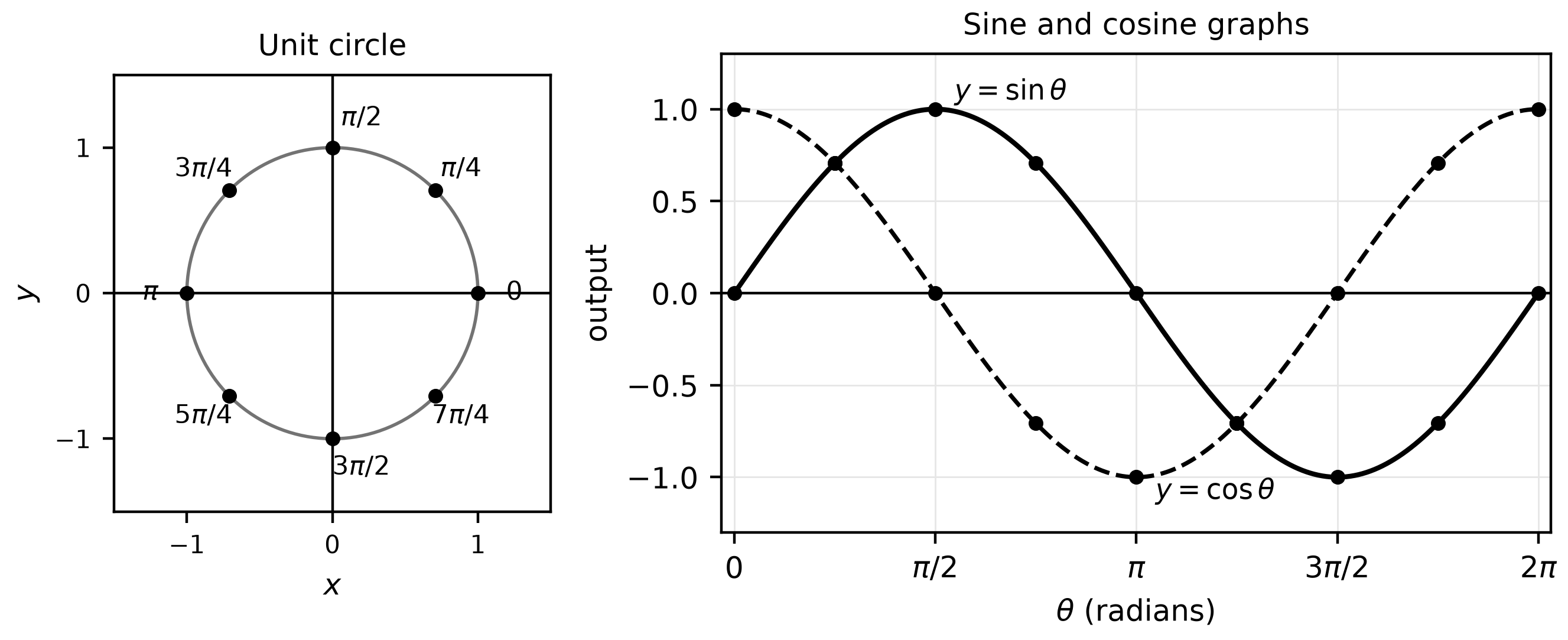
Figure 13.4. Each marked point on the circle supplies one value of sine (its vertical displacement) and one value of cosine (its horizontal displacement).
Worked example 13.6: value, direction and rate are separate claims
Describe on . As increases, moves from toward . It stays above the -axis, so the sine is positive, but it moves down, so the sine is decreasing.
Rates of change add a third description. On the average rate of change of sine is per radian. On it is per radian. The sine increases on both intervals but more slowly near the top, so its graph is concave down there. A graph above the axis may be decreasing, and an increasing graph may be slowing down.
Worked example 13.7: coordinates of a moving point
A point starts at on a circle of radius 4 centered at the origin and moves counterclockwise through radians. Its starting angle is , so after the rotation its angle is :
The simplification uses the circle's symmetry: adding moves to the opposite point, which reverses both signs. Check: , and , a quarter turn counterclockwise from the left end of the circle to its bottom.
For angles without exact values, use a calculator in radian mode. A point that starts at and turns 1 radian is at . Degree mode would treat the input as 1 degree and report about , a point barely above the axis; an estimate of where 1 radian lies, a little less than , exposes the error.
Try it 13.4. A periodic function has period 5 and . Find and .
Check your work. and , so both values equal .
Error analysis: an answer the circle rejects
A student finds the -coordinate of the point reached by an arc of length 2 on the unit circle, starting from and moving counterclockwise, and reports . Estimate first: 2 radians is a little more than , so the point is just past the top of the circle and its -coordinate should be close to 1. The reported value belongs to 2 degrees. In radian mode, . The repair is to check the mode and compare every calculator output with a quick location on the circle.
Retrieval and review
At your next study session, draw the unit circle from memory and mark the exact coordinates at every multiple of and in one quadrant, then use signs to fill the others. About a week later, explain in your own words why a radian does not depend on the size of the circle, and test a proposed period by checking direction as well as height. In Chapter 14 you will transform these graphs; keep this chapter's displacement meaning in mind when you interpret amplitude and midline.
Practice
Fourteen multiple-choice questions, Questions 191–204, are printed after this chapter. Questions 191–201 are no-calculator questions. Questions 202–204 require a graphing calculator in radian mode. Keys and explanations for every choice are under Chapter 13: answers and explanations. For each miss, record whether the error came from the period, the radian measure, a sign or the calculator mode, then redo the matching worked example before trying a fresh question.