What to practice
- Explain branch restrictions, reciprocal functions, asymptotes and inverse values.
Sine and cosine describe positions on a circle. This chapter adds the functions built from them: tangent, which measures the slope of a terminal ray; the inverse functions, which turn a ratio back into an angle; and secant, cosecant and cotangent, the reciprocals. It covers topics 3.8, 3.9 and 3.11 of the AP Precalculus Course and Exam Description. Chapter 16 uses all three tools to solve equations.
Prerequisite check: give and exactly, and name the quadrants in which the cosine is negative. If either answer is uncertain, review "Exact values from special triangles" in Chapter 13.
Tangent as the slope of the terminal ray
For an angle in standard position whose terminal ray passes through with ,
The ratio is the slope of the line through the origin and , so the tangent of an angle is the slope of its terminal ray. A steep ray has a tangent of large size; a horizontal ray has tangent 0; a vertical ray has no slope, so the tangent is undefined wherever .
The slope view also explains the period. Adding to an angle turns its terminal ray to point the opposite way along the same line, from to . The slope does not change, so , and the period of tangent is , half the period of sine and cosine.
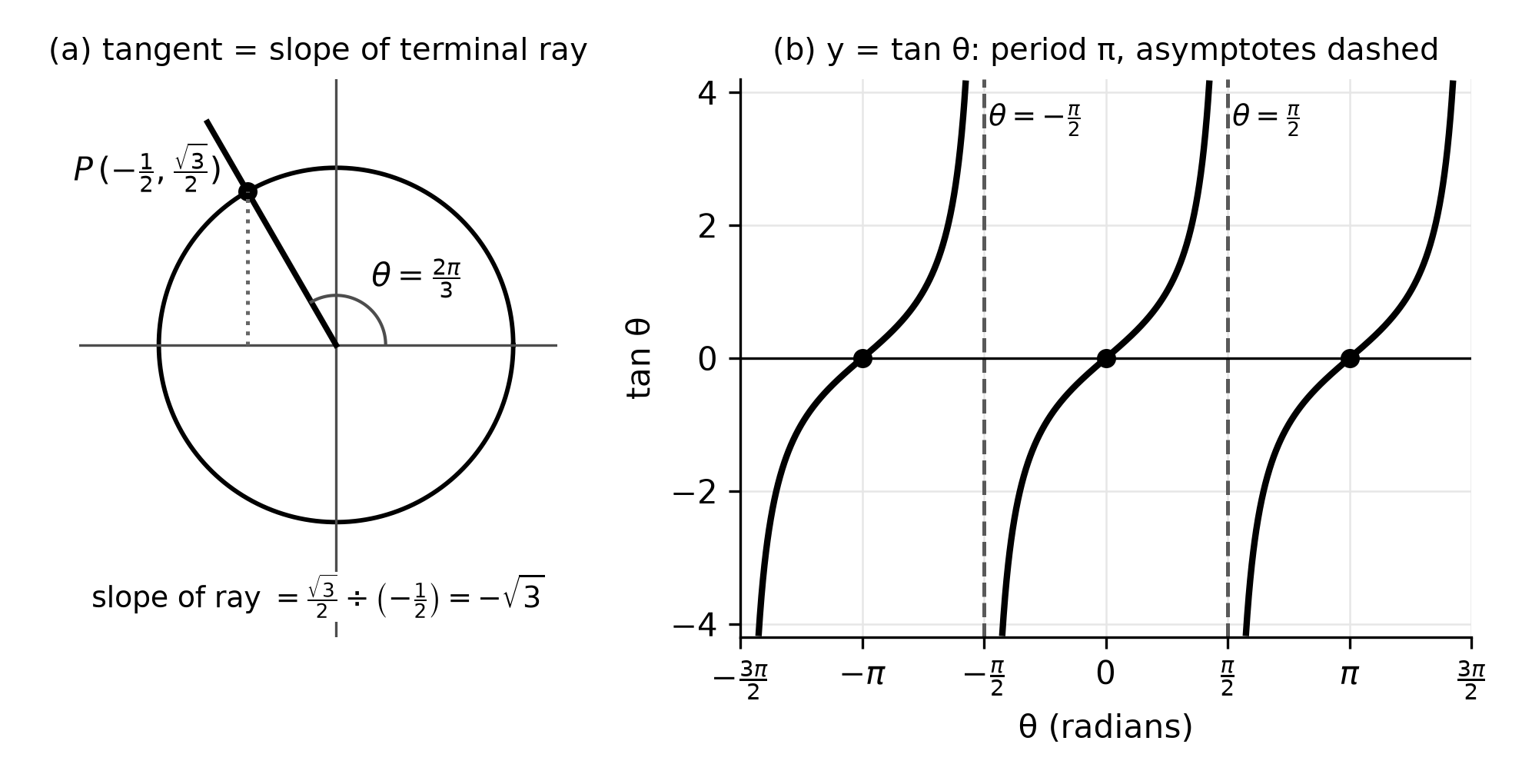
Figure 15.1. Tangent read as a slope (left) and the repeating branches of the tangent graph (right).
Worked example 15.1: slope, sign and quadrant
The terminal ray of passes through . Its slope is , so . The tangent is positive even though both coordinates are negative, because the line containing a Quadrant III ray also passes through Quadrant I and rises from left to right. In panel A of Figure 15.1 the ray at falls from left to right, and . The sign of the tangent is positive in Quadrants I and III and negative in Quadrants II and IV.
Graph and transform tangent
The graph of has these properties.
- Domain: all real numbers except for integers . Vertical asymptotes stand at those inputs, because the cosine in the denominator is 0 there.
- Range: all real numbers. Period: .
- Behavior: increasing on every interval between consecutive asymptotes. On the graph is concave down, and on it is concave up, so each zero is a point of inflection. Tangent is an odd function: .
The transformations of Chapter 14 apply. For
the period is , the graph shifts horizontally and vertically, and stretches it vertically. A tangent graph has no amplitude, because its outputs are unbounded; instead sets how fast the graph climbs. When the graph is reflected, and every branch is decreasing.
Worked example 15.2: a transformed tangent
Graph .
Center and period. The point that came from moves to , the inflection point of one branch. The period is .
Asymptotes. The parent asymptotes occur where the argument equals . Solve to get , and to get . All asymptotes are .
Quarter points. Halfway from the center to each asymptote, the argument is and is : and . Because , the branch on increases, concave down before and concave up after it.
Try it 15.1. For , give the period, the two asymptotes nearest and the behavior on the branch through .
Check your work. The period is . Solve : the asymptotes are . Since , the branch is decreasing; it is concave up on and concave down on .
Restrict and invert
Sine, cosine and tangent repeat their outputs, so none of them is one-to-one and none has an inverse on its full domain. To build an inverse, keep one interval on which the function takes each of its outputs exactly once. The conventional choices are these.
| Function restricted to | Inverse | Domain of inverse | Range of inverse |
|---|---|---|---|
| on | |||
| on | |||
| on | all real numbers |
The inverse sine is also written ; the exponent means inverse, not reciprocal, so . Each inverse takes a ratio as input and returns an angle in radians. As with any inverse, its graph is the reflection of the restricted graph across , and the arctangent graph has horizontal asymptotes .
In a context, read the output as an angle. A constructed access ramp rises 1.2 meters over a horizontal run of 10 meters. Its slope is 0.12, so the ramp meets the ground at an angle of radian. The arctangent fits here because a slope is a tangent value, and the restricted range is no obstacle: a ramp's angle with the ground lies between 0 and .
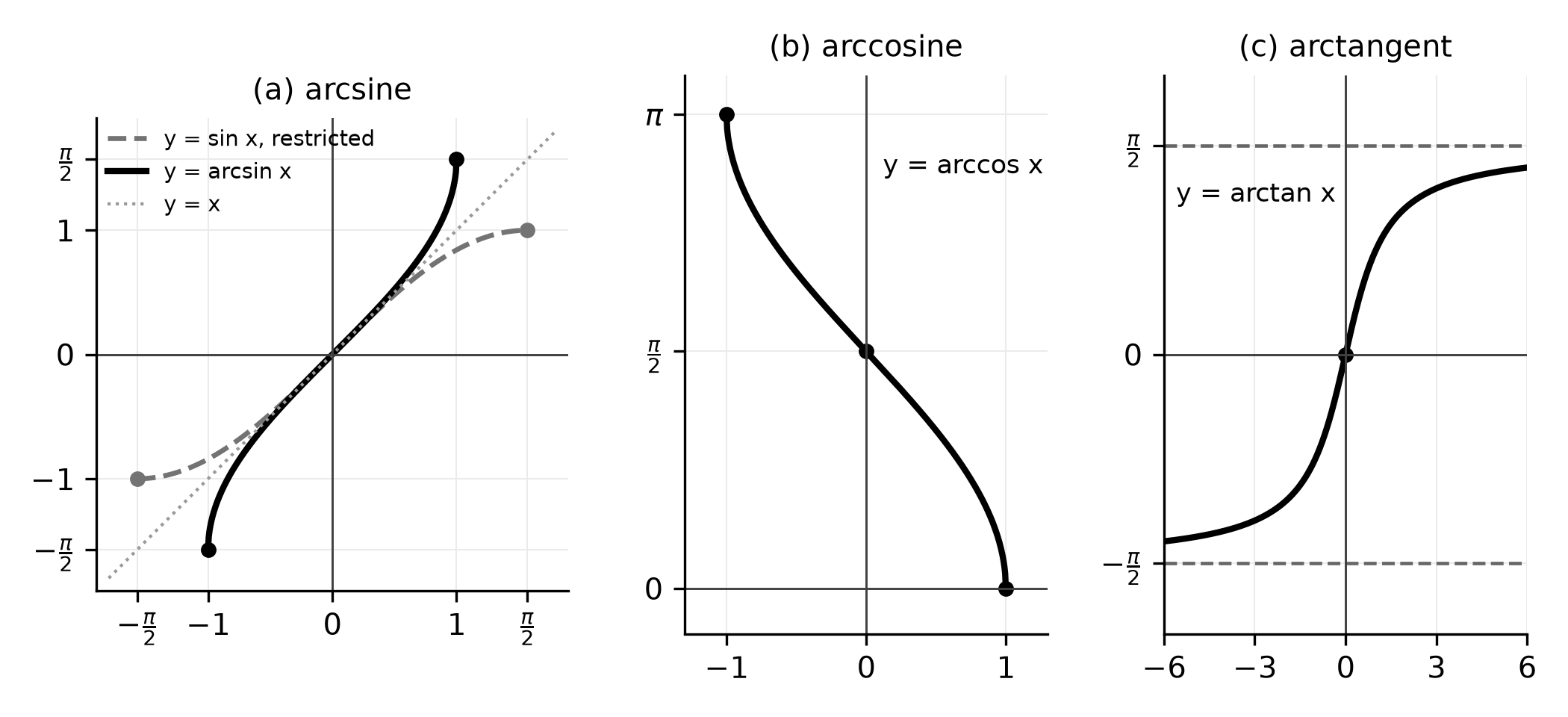
Figure 15.2. The three inverse trigonometric functions. Each output interval is the restricted domain of the original function.
Worked example 15.3: one inverse value, more than one solution
, because lies in and . The equation on , however, has two solutions, and . The inverse function supplies exactly one angle; symmetry of the circle supplies the rest. A question that asks for an inverse value wants one number, while a question that asks for solutions wants every angle in the stated interval.
Worked example 15.4: compositions
(a) . First, . The arcsine returns the angle in with that sine, . The answer is not , which lies outside the range. In general for every in , but only when lies in .
(b) . Let , so lies in Quadrant IV with . The point is on its terminal ray, at distance 5 from the origin, so . Placing the point at would give the wrong sign: that point is on the opposite ray.
Try it 15.2. Evaluate , and .
Check your work. , and . In each case the inner value is computed first and the outer function returns the angle in its own range.
Worked example 15.5: an angle from a calculator
Find the angle , with , of the ray from the origin through . A calculator in radian mode gives , an angle in Quadrant IV. The point is in Quadrant II, so that output names the opposite ray. Add : . Check: and , matching and . A result of 143.13 means the calculator was in degree mode.
Try it 15.3. With a calculator, find the angle in of the ray through .
Check your work. is in Quadrant I; the point is in Quadrant III, so .
Reciprocal functions: secant, cosecant and cotangent
Each reciprocal function divides 1 by a function from earlier chapters:
Where , also . Each pair contains exactly one name that begins with "co": cosecant goes with sine and secant goes with cosine.
Graph a reciprocal from its partner. Where the partner equals 1 or , the reciprocal has the same value. Where the partner approaches 0, the reciprocal grows without bound, and a vertical asymptote appears where the partner equals 0. A maximum of a positive partner becomes a local minimum of the reciprocal. As a result, the secant and cosecant never take values between and 1: their range is or . Secant and cosecant have period ; cotangent has period , has asymptotes at the zeros of sine, , and decreases between them. On , the cotangent graph is concave up before its zero at and concave down after it, the reverse of the pattern for a tangent branch.
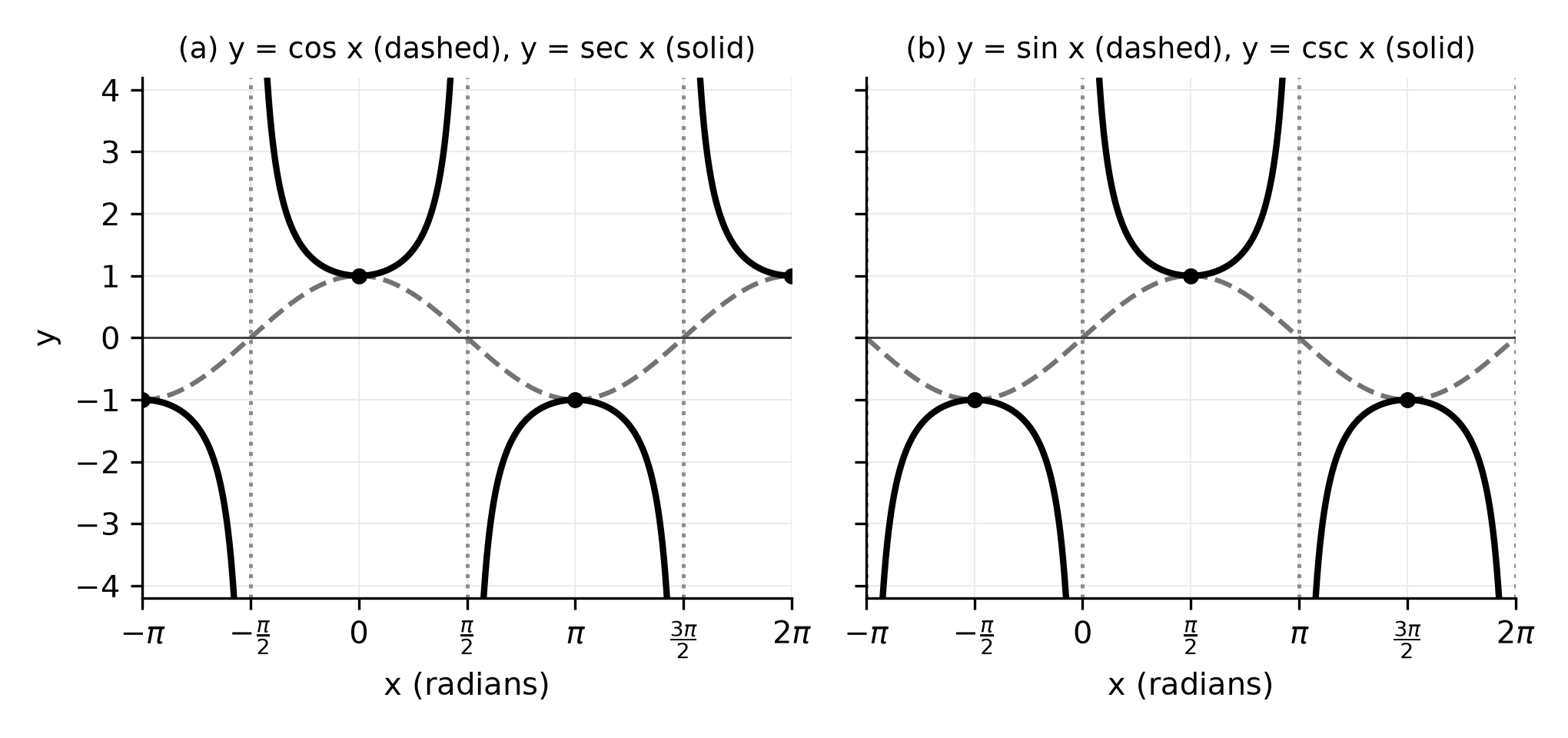
Figure 15.3. Secant and cosecant drawn with their partners. Each branch touches its partner only where the partner equals 1 or .
Worked example 15.6: exact reciprocal values
. Next, . Finally, . Find the sine or cosine first, with its sign, and only then take the reciprocal.
Worked example 15.7: rewrite and keep the domain
Rewrite with a single trigonometric function. Replace each function with sines and cosines:
The original expression needs and , so only for . At , but is undefined, so and are not the same function. State the restriction whenever a cancellation removes a factor that could be 0.
Try it 15.4. Find , and exactly.
Check your work. , and .
Common errors to check
- Ratio upside down. Tangent is ; cotangent is the reverse.
- Wrong period. Tangent repeats every , and every .
- Shifted asymptotes guessed. Find asymptotes of a transformed tangent by setting the whole argument equal to and solving.
- Reciprocal read as inverse. is an angle; is .
- Output outside the range. An arcsine or arctangent value lies between and ; an arccosine value lies between 0 and .
- Calculator quadrant. The arctangent of a ratio lands in Quadrant I or IV; add when the point is in Quadrant II or III.
- Lost restriction. A simplified expression is equal to the original only on the original's domain.
Retrieval and review
At your next study session, rebuild the restriction table from memory and sketch the three inverse graphs. Then write the asymptotes of and the range of without notes. About a week later, explain in two sentences why and why can differ from . Chapter 16 uses these inverse values to solve equations on intervals.
Practice
Fourteen multiple-choice questions, Questions 223–236, and one free-response task, Written task 16, are printed after this chapter. Questions 223–234 and the free-response task are no-calculator work; Questions 235 and 236 require a graphing calculator in radian mode. Keys, explanations and a scoring rubric are under Chapter 15: answers and explanations. For each miss, record whether the error came from a slope, a period, a restricted range, a reciprocal or a lost domain restriction, then redo the matching worked example before trying a fresh question.