What to practice
- Establish identities on appropriate domains and solve equations/inequalities without losing solutions.
Start with what the equation asks
A trigonometric equation asks for every input angle that produces a required output. Because sine and cosine repeat every , an equation with one solution usually has infinitely many, and a stated interval or a context decides which of them count. This chapter builds two habits on the exact values and inverse functions of Chapters 13 to 15: find the complete solution set on the stated interval, and rewrite an expression only where the new form is still equivalent.
Check three prerequisites without looking back: the exact sine and cosine of , and ; the quadrants in which sine is negative; and the output interval of . If any answer is uncertain, review "Exact values from special triangles" in Chapter 13 and "Restrict and invert" in Chapter 15.
Find every solution in an interval
Use one routine whenever an equation can be written as a single trigonometric function equal to a constant.
- Isolate the trigonometric expression, for example .
- Check the value. Sine and cosine outputs lie in , so a value outside that interval gives no solution.
- Find the reference angle from , then use the sign of to choose the quadrants.
- List the solutions in one full period, then add or subtract multiples of the period that keep the answer inside the required interval.
- Substitute each answer into the original equation.
An inverse function supplies only one angle: returns values in and values in . Treat that answer as a starting angle, move it into the required interval and look for the second angle in the same period.
Worked example 16.1: one cosine value, two angles
Solve for .
Subtract and divide by 2 to get , a value inside . The reference angle for is . Cosine is the horizontal coordinate on the unit circle, so a negative value places the angle in Quadrant II or Quadrant III (Figure 16.1).
Check: both angles have horizontal coordinate , so at each. Over all real numbers the solutions are and for integers . The inverse value gives only the first angle.
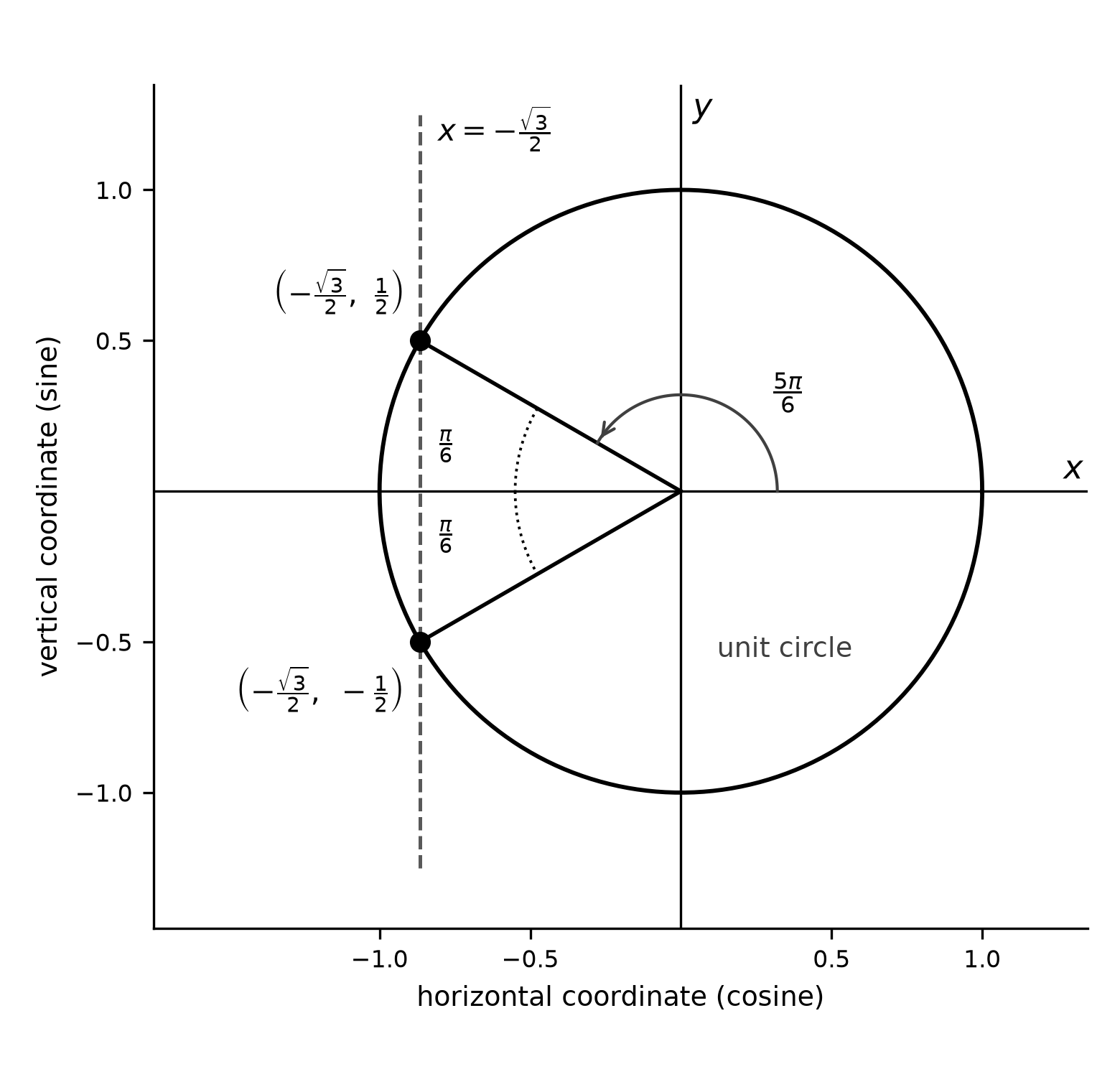
Figure 16.1. A horizontal coordinate of occurs at two points of the unit circle in each revolution.
Worked example 16.2: a multiple angle widens the search
Solve for .
Let . As runs through , runs through , which is two full periods of sine. The reference angle is , and a negative sine places in Quadrants III and IV: or in the first revolution, and or in the second. Divide each by 2.
Each solution checks, because each value of is one of the four angles found for . Figure 16.2 confirms two cycles and four intersections. Stopping after the first revolution finds only two solutions.
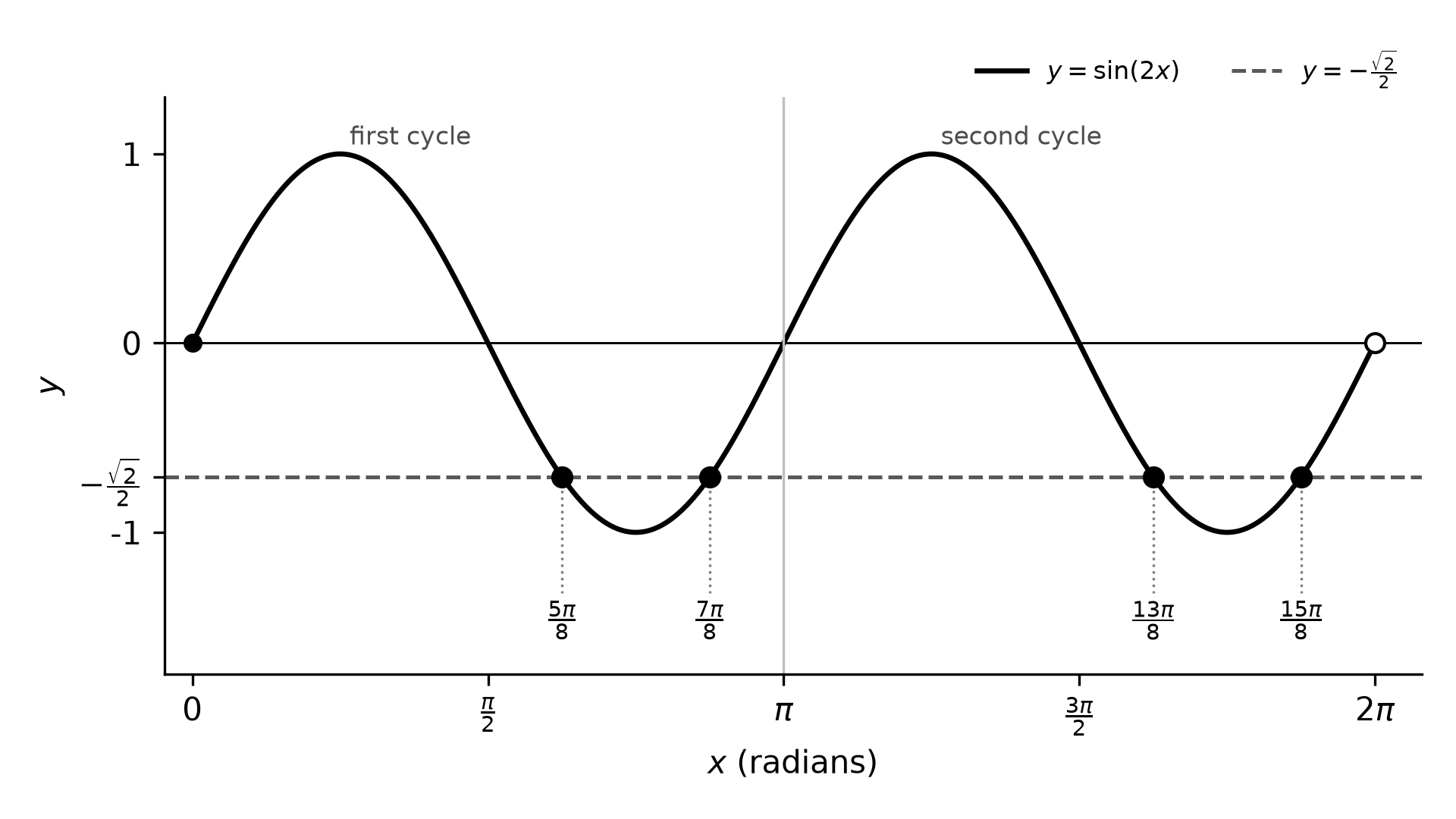
Figure 16.2. Four solutions in , because the period of is .
Factor instead of dividing
Dividing both sides by a trigonometric expression assumes that it is not zero; if it can be zero on the interval, the division deletes solutions. Instead, move every term to one side, factor, solve each factor and keep every candidate that satisfies the original equation.
Worked example 16.3: keep the zero factor
Solve for .
Subtract to get , then factor out : .
- The factor gives and .
- The factor gives and .
All four values satisfy the original equation; at and both sides equal 0. Dividing by at the start would have lost 0 and .
Worked example 16.4: reject an impossible value
Solve for .
Two different functions appear. Every point lies on the unit circle, so ; this identity is developed later in the chapter. Substituting leaves one function:
Treat as one unknown and factor: . The factor is impossible, because sine never leaves ; reject it and say why. The factor gives . Check: . One impossible factor does not make the whole equation impossible.
Solve inequalities from boundary points
To solve an inequality such as , first solve the matching equation. For a continuous function, its solutions are the only places where the inequality can change from true to false. Then test one input in each piece of the interval, or read the unit circle or a graph, and decide whether the boundary points belong: and include them, while and exclude them. Dividing by a negative number reverses the inequality, exactly as in algebra.
Worked example 16.5: a context sets the domain
A constructed practice model gives the water depth at a dock as meters, where is hours after 6:00 a.m. and . When is the depth at least 6 meters?
Find the boundary first: gives . The domain makes run through , one cycle, in which sine equals at and . The boundary times are therefore and . Test each piece: , while and fail.
The depth is at least 6 meters for , from 7:00 a.m. to 11:00 a.m. (Figure 16.3). The general solutions continue indefinitely, but the model covers one 12-hour period, so a claim about 7:00 p.m. would extrapolate beyond its domain.
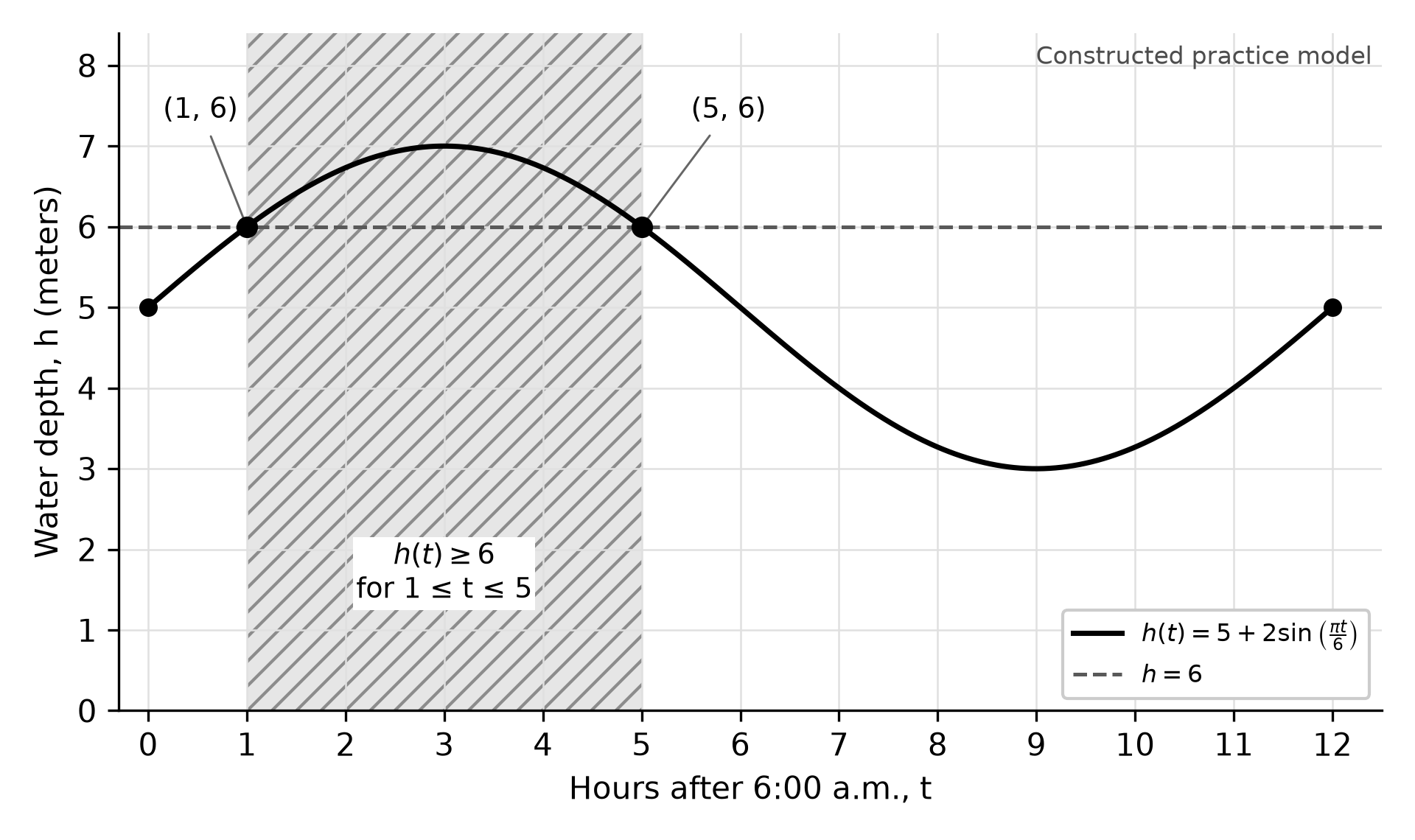
Figure 16.3. Constructed practice model. The hatched band is where the curve is on or above the line .
Rewrite with identities for a purpose
An identity is an equation that is true for every input in a stated domain. Rewrite with an identity when the new form exposes a single function, a factor, an exact value or a cleaner graph. Two functions are equal only when they have the same domain and agree at every input of that domain, so record any input at which one form is undefined.
The Pythagorean identity and its relatives
The point at angle on the unit circle is . The right triangle from that point to the horizontal axis has legs and and hypotenuse 1, so for every real
Rearranging gives and . Dividing by , which is allowed only where , gives . Dividing by , where , gives . The division step is the reason these two identities carry restricted domains.
Domain matters even when the algebra is correct. The expression equals only where . At the original expression is undefined, while equals 0, so the two graphs match except for holes at those inputs.
The identity also supports inverse relationships with restrictions: for , , since both sides name the first-quadrant angle whose sine is . For negative the left side is negative and the right side is not.
Sum, difference and double-angle identities
For all real and :
Replacing with , and using and , gives the difference identities and . Setting in the sum identities gives the double-angle identities.
Choose the form of that matches the rest of the problem; the last form helps when every other term involves sine. Sine and cosine do not distribute over a sum: is not .
Worked example 16.6: an exact value from a sum
Find the exact value of .
Write the angle as a sum of familiar angles, , and apply the cosine sum identity.
Check the sign and size: the angle lies in Quadrant II, where cosine is negative, and the value, about , is small because the angle is only slightly larger than .
Worked example 16.7: an identity holds on a stated domain
Show that , and state where the equation holds.
Choose double-angle forms that simplify the left side: , and the form cancels the constant in the denominator, so . Then
Cancelling requires . The left side is undefined exactly when , which happens when , and is undefined at the same inputs. So the equation is an identity on the full domain . Testing , where both sides equal , is a useful check, but agreement at sample inputs never proves an identity.
Worked example 16.8: rewrite, then solve
Solve for .
The equation mixes a double angle with a single angle. Use so that only remains.
So , giving or , or , giving . Check the last value: . The form would have left two functions.
Common errors to check
| Error | Repair |
|---|---|
| Stopping at the single angle an inverse function returns | Worked example 16.1 |
| Searching only one revolution for a multiple angle | Worked example 16.2 |
| Dividing by an expression that can be zero | Worked example 16.3 |
| Rejecting a whole equation because one factor is impossible | Worked example 16.4 |
| Not reversing an inequality after dividing by a negative; ignoring boundaries or the context's domain | Worked example 16.5 |
| Distributing sine or cosine over a sum | Worked example 16.6 |
| Calling two expressions equal without comparing domains | Worked example 16.7 |
Try it
Try it 16.1 (partly guided). Solve for . Start from . Which two angles are the boundary points, and does the solution include them?
Try it 16.2. Solve for .
Try it 16.3. Solve for .
Try it 16.4. Show that wherever the left side is defined, and name the excluded inputs.
Check your work.
16.1. The boundary points solve : and . Between them sine is below ; for example, . The inequality is strict, so the solution is , without the boundaries.
16.2. The reference angle is , and tangent is negative in Quadrants II and IV. In the solutions are and . They differ by the period of tangent, ; supplies only the first.
16.3. Replace with to get , which factors as . The solutions are , and , and each checks in the original equation.
16.4. Write and cancel the factor , which is allowed only where . The left side is undefined at , where the right side equals 2, so the equation holds for every .
Review and retrieval
Close the book and write the five-step routine and the three forms of . Tomorrow, redo Worked example 16.3 on blank paper and explain why dividing loses solutions. In about a week, redo Try it 16.3 and say which identity you chose. Chapter 17 uses these exact values to locate polar points; Chapter 19 returns to symbolic written work, where every rejected candidate needs a stated reason.
Practice
Fourteen multiple-choice questions (Questions 237–250) and one six-point symbolic free-response task (Written task 17) follow this chapter under Printed practice; no calculator is permitted. Keys, the reasoning behind every choice and the scoring guide with a sample response are under Chapter 16: answers and explanations. For each miss, name the error from the table above and redo its worked example before a fresh attempt.