What to practice
- Develop complete responses for the four FRQ types and diagnose missing support.
A free-response scorer can award only what is on the page. A correct idea that stays in your head, or a calculator value with no equation behind it, gives the scorer nothing to credit. This chapter shows what a complete written response looks like for each of the four free-response tasks and how to repair a response that is missing support.
The May 2027 exam gives the four tasks in a fixed order. Part II-A (35 minutes, graphing calculator required) contains Task 1, function concepts, and Task 2, a non-periodic model. Part II-B (35 minutes, no calculator) contains Task 3, a periodic model, and Task 4, symbolic manipulation. Each task is worth six points, and the four tasks carry equal weight. You read the prompts on screen and handwrite your answers in a paper booklet. Calculator work uses radian mode. (AP Precalculus exam overview; Course and Exam Description)
What a point needs
Every point in this book's rubrics names one piece of evidence. Five habits produce most of that evidence.
- Show the chain. Write before the number. A bare value hides which input you used.
- Write the setup before a calculator result. Record the equation you solved, then the result. Unless a prompt says otherwise, this book asks for decimals correct to three places after the decimal point, with no rounding of intermediate values.
- Attach units and context. "1.5 meters per second" answers a rate question; "1.5" does not.
- Put the reason in the same sentence as the claim. "The rate of change is increasing because the average rates on consecutive one-unit intervals are 2, 3 and 5."
- Carry restrictions. State the domain before you cancel, combine or apply an inverse, and check every candidate in the original statement.
An early arithmetic error need not cost later points. Each rubric in this book states when a later point accepts a value carried forward from your own earlier work. No rubric gives credit for an unsupported claim or for a conclusion that contradicts your own values.
Task 1: function concepts (calculator)
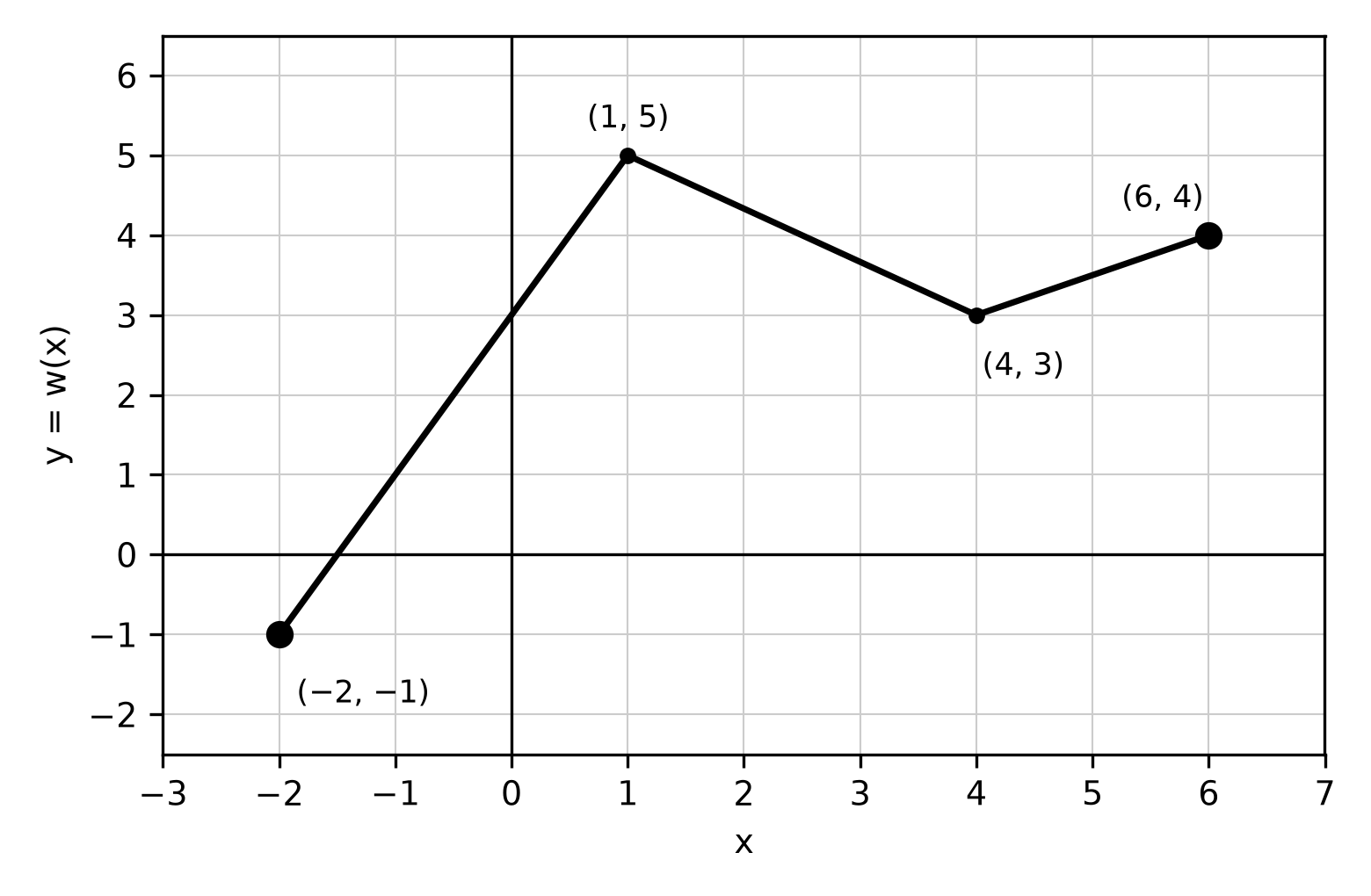
Figure 19.1. The function w, defined only for −2 ≤ x ≤ 6.
Worked example 19.1: a chain, a domain and a calculator setup
Let , and let w be the function in Figure 19.1.
(a) Find . "From the graph, , so ." The inner value comes from the graph and the outer value from the formula; writing shows both steps.
(b) Explain why is undefined. ". The domain of w is −2 ≤ x ≤ 6, and 9.391 is not in it, so is undefined." The point needs the intermediate value and the domain comparison. "It is off the graph" names neither.
(c) Find the value of x for which . ", so , , and ." Writing the equation is what makes 4.799 checkable; a scorer cannot tell where a lone decimal came from.
Function-concept tasks also test vocabulary that sounds informal but is precise. Two functions are equal only when they have the same domain and the same output at every input in it; matching formulas on part of a domain is not enough. An inverse value such as exists only if exactly one input of w produces 3. In Figure 19.1, w equals 3 at x = 4 and also at one input between −2 and 1, so the answer would have to say that w is not one-to-one on its full domain.
Task 2: non-periodic model (calculator)
Worked example 19.2: parameters, meaning and a limit
Constructed practice data: a drink cools in a room. Let D(t) be the drink's temperature minus the room's temperature, in degrees Celsius, t minutes after it was poured. Measurements give and . The model is .
(a) Find a and b. " and . Dividing, , so . Then ." Check: .
(b) Interpret b. "Each minute, the temperature difference is multiplied by 0.8, so it decreases by 20% per minute." A response that says "b is the rate" earns nothing: the meaning is a multiplicative change per unit of time.
(c) Estimate D(10) and describe a limit on the estimate. ", so the model predicts the drink is about 6.979 °C warmer than the room after 10 minutes. The measurements cover only 1 ≤ t ≤ 4, so this is an extrapolation; it is trustworthy only if the difference keeps shrinking by the same factor each minute." A limitation earns credit when it is tied to this model and these data. "Models are never perfect" is not a limitation of anything in particular.
When a task supplies data and a regression, define every residual the same way: observed value minus predicted value. A residual of −0.4 means the model overpredicts that observation by 0.4 units. State which way the model errs, not just the size of the error.
Task 3: periodic model (no calculator)
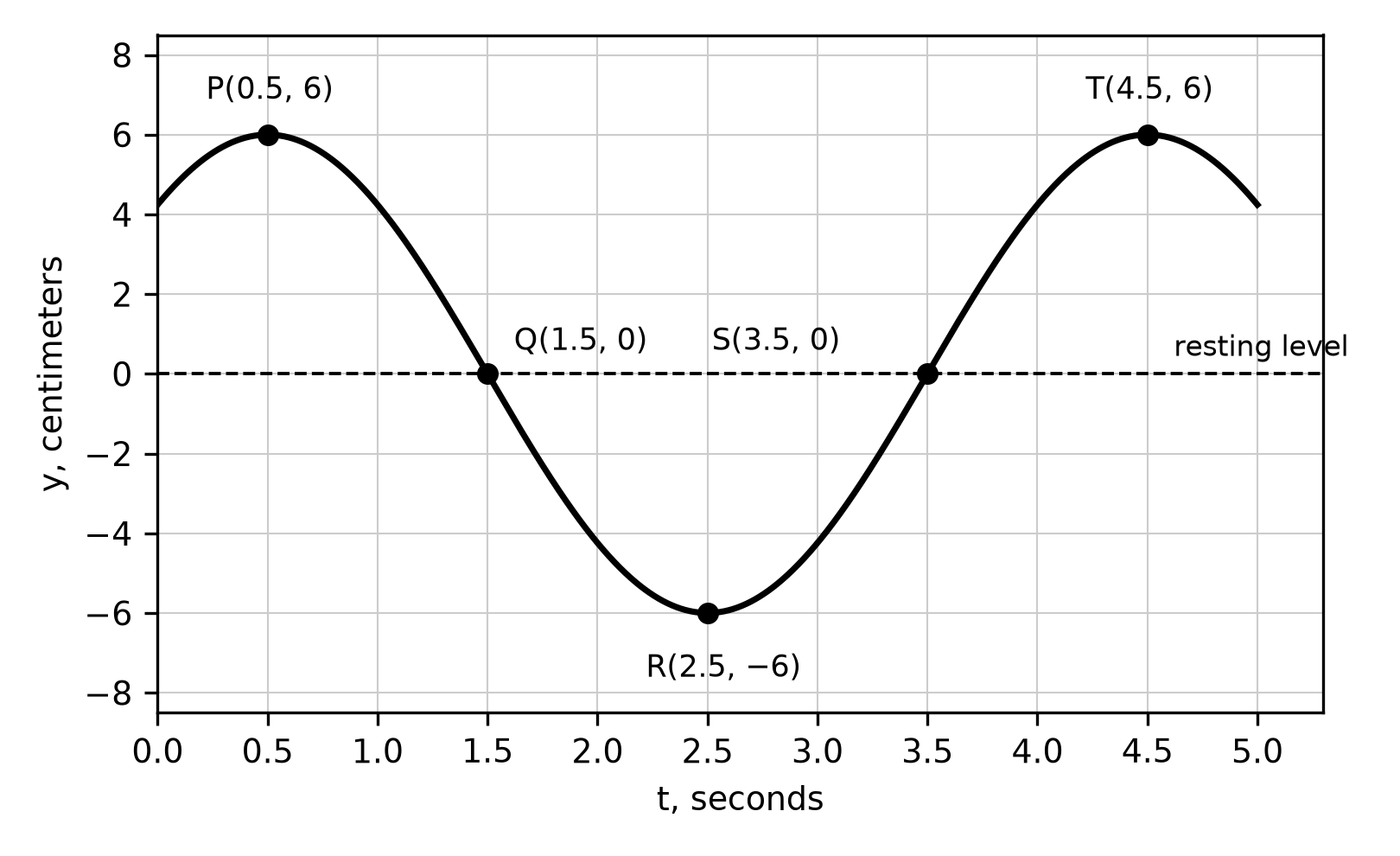
Figure 19.2. Constructed model of a cork bobbing on water: displacement above its resting level.
Worked example 19.3: label a cycle, then justify behavior
Use Figure 19.2.
(a) Period and amplitude. "P and T are consecutive highest points, so the period is 4.5 − 0.5 = 4 seconds. The amplitude is (6 − (−6))/2 = 6 centimeters, and the midline is y = 0."
(b) Write . " and . A sine function with crosses its midline while increasing at the start of a cycle; that happens at S, t = 3.5, and one period earlier at t = −0.5. So and ." Check at P: . Testing a second labeled point catches a phase shift with the wrong sign.
(c) Between R and S, is y increasing or decreasing, and is its rate of change increasing or decreasing? "From R to S the graph rises from its lowest point to the midline, so y is increasing. On this quarter-cycle the graph is concave up: the rate of change grows from 0 at R to its greatest value at S, so the rate of change is increasing." Both claims carry a reason taken from the cycle. The current course guidance does not assess whether the endpoints of such an interval are included, so do not spend time on that question (Fall 2026 clarifications and corrections).
Task 4: symbolic manipulation (no calculator)
Worked example 19.4: keep the restriction visible
Solve .
"Domain: and , so . For ,
So , , and . Because 6 > 3, the solution is x = 6. Check: ."
The simplified expression is defined for every x > −3, a larger set than the original domain. The two expressions agree only for x > 3, which is why the domain line comes first.
Score a weaker response
Worked example 19.5: decide each point separately
A student answered Example 19.2 this way: "a = 65 and b = 0.8. b means the temperature goes down by 0.8 each minute. D(10) = 6.979."
- Parameters: not earned. Two bare numbers could come from guessing. The point needs the equations from both measurements or the ratio .
- Interpretation of b: not earned. "Goes down by 0.8" describes subtraction. The model multiplies by 0.8.
- Value of D(10): earned. 6.979 is the correct model value; adding "degrees Celsius above room temperature" would complete it.
- Limitation: not earned. It is missing.
The repair is short: write the two equations, replace "goes down by 0.8" with "is multiplied by 0.8 each minute," and add one sentence about extrapolating beyond 1 ≤ t ≤ 4. Notice that the student did the hardest calculation correctly and still lost three points to missing words.
Try it
19.1. Using Figure 19.1 and , a student writes "." Write the complete chain and decide whether the student is right.
19.2. In Example 19.4, suppose the right side were 1 instead of 2. Solve the new equation, keeping or rejecting each candidate with a reason.
Check your try-it work
19.1. , which is in the domain of w. On the segment from (−2, −1) to (1, 5) the slope is 2, so . Thus ; the student is wrong, probably from reading the graph at x = 2 instead of at the intermediate value 0.25.
19.2. For x > 3 the equation becomes , so x + 3 = 3 and x = 0. Because 0 is not greater than 3, it is rejected: the original logarithms are undefined at x = 0. The equation has no solution.
Practice
After this chapter, the printed practice contains four written tasks, printed as Written tasks 18–21. Written task 18 is a function-concepts task (graphing calculator required). Written tasks 19 and 20 are periodic-model tasks, and Written task 21 is a symbolic task; these three are no-calculator work. Allow about 17 minutes per task, write on the two response pages provided, and then score your own work with the rubric under "Chapter 19: answers and explanations." Each explanation also scores a weaker response point by point; compare its decisions with yours before reading the model response. Non-periodic modeling tasks appear in the practice for Chapters 6, 8, 9 and 12.
Before you move on
Without looking back, write the five habits from "What a point needs." Mark every point you lost on the practice tasks as one of these: meaning, representation, method choice, execution, validity or communication. In about a week, redo Example 19.4 and Try it 19.2 on blank paper, then rewrite one of your own lost points as a complete sentence with its reason.