What to practice
- Select a method on unseen work, explain the choice and revisit diagnosed errors.
Inside a chapter, the heading tells you which method to use. On the exam, nothing does. A logarithm question can sit between a polar question and a rational one, and the calculator part mixes problems that need a graph with problems that are faster by hand. Transfer means noticing the feature that decides the method, then checking that the answer fits the stated conditions.
Mixed practice feels harder than blocked practice, and that difficulty is useful. In a controlled study of mathematics practice, mixing problem types lowered scores during practice but improved later test performance and the choice of procedure (Taylor and Rohrer, interleaved mathematics practice). That study did not involve this course, so treat it as a reason to try mixing, not as a promise. The IES practice guide on organizing study gives related advice: space your review and answer questions that ask why, not only what.
Read the features before choosing a method
Before you calculate, name what you see. The table pairs common features with a first method and the check that most often catches an error.
| Feature you notice | First method to try | Check before you finish |
|---|---|---|
| Both sides are powers of one base | Match the exponents | none beyond arithmetic |
| A variable exponent with no common base | Take a logarithm of both sides | each logarithm's domain |
| Two different families, such as an exponential and a line | Graph both and intersect (calculator part) | the window and the stated domain |
| Equal input steps in a table | Compare differences and ratios | whether the pattern holds at every step |
| A product or quotient of expressions | Factor and use each factor | excluded inputs and lost factors |
| A squared or doubled trigonometric expression | Factor or use an identity; never divide by a variable expression | every solution in the interval |
| A polar radius that can be negative | Track the sign of r and the distance separately | direction and distance |
Two features hide easily. A factor shared by the numerator and denominator of a rational expression signals a hole, not a vertical asymptote, so record the excluded input before you cancel. A sum of logarithms invites combining, but the combined form can be defined at inputs where the original is not, so every candidate goes back into the original equation. In both cases the fast algebra is fine; skipping the record is the error.
Worked example 20.1: three equations that look alike
(a) . Both sides are powers of 2, and , so x = 5. No logarithm is needed.
(b) . No common base exists, so take logarithms: . Check: is about 20.
(c) , with the stated condition x ≥ 0. The variable appears in an exponent and outside it, so no algebraic step isolates x. Graph and and find their intersections (Figure 20.1). There are two, near x = −2.863 and x = 2.445. Only x ≈ 2.445 satisfies x ≥ 0.
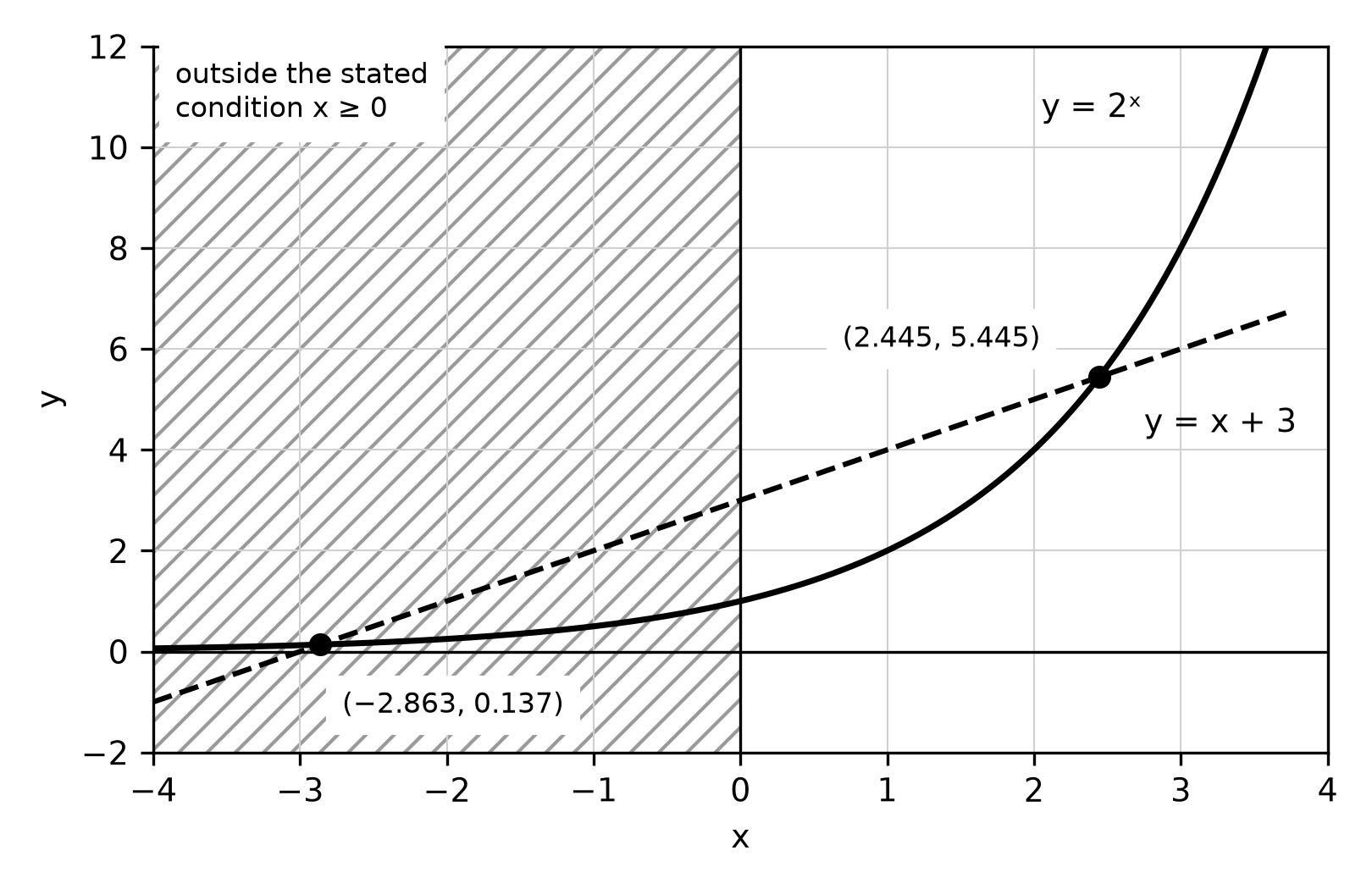
Figure 20.1. Two intersections; the stated condition keeps only one.
The structure of each equation chose the method. The condition chose the final answer. A calculator that reports the first intersection it finds can report the wrong one, so look at the whole graph before you trust a single value.
Worked example 20.2: an increasing table does not name its family
Figure 20.2 plots three constructed tables. All three increase. Tables A and B even share both endpoints, (0, 3) and (4, 19), so they have the same average rate of change, 4, on 0 ≤ x ≤ 4. That rate cannot tell them apart.
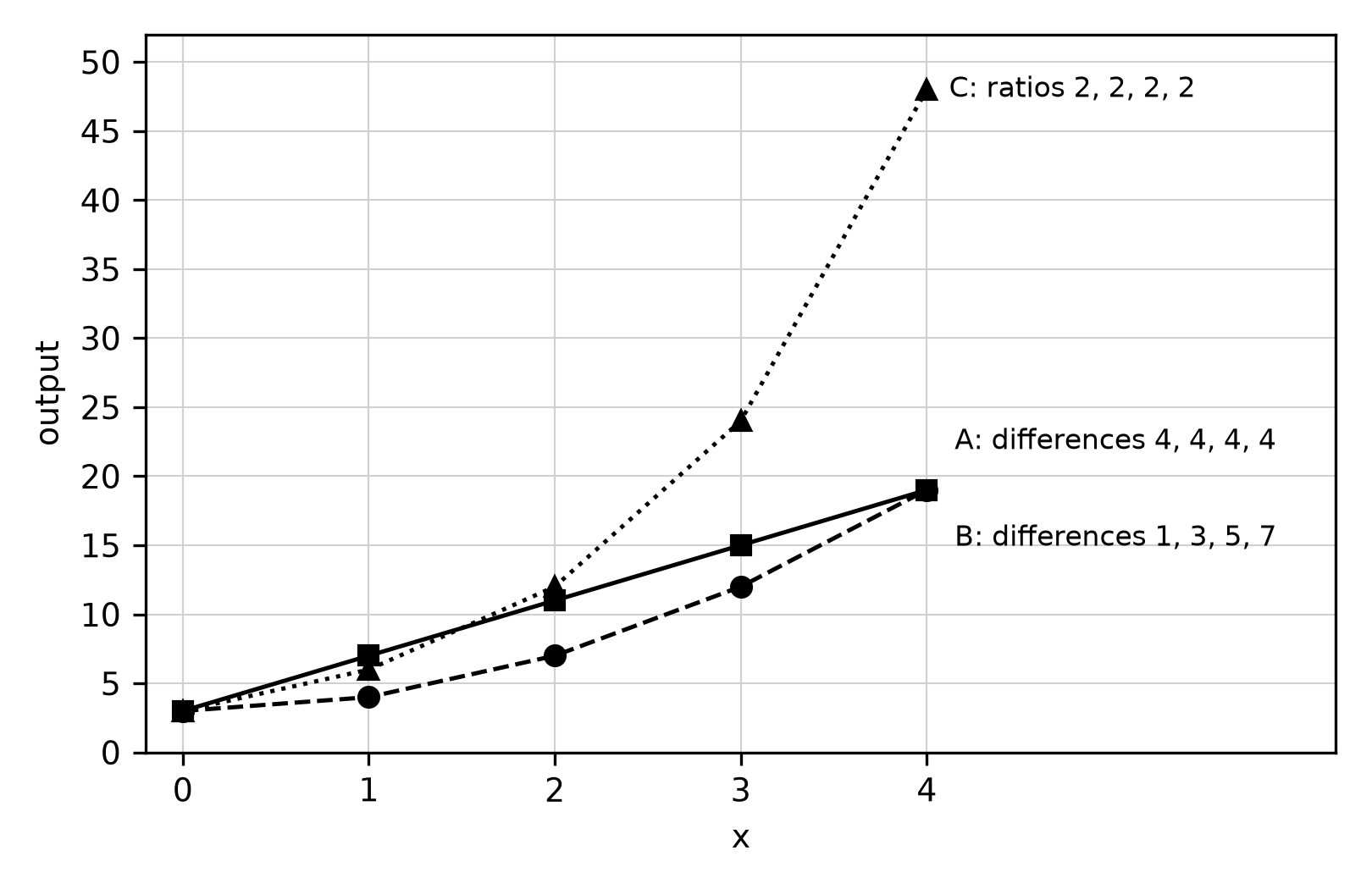
Figure 20.2. Three increasing tables with equal input steps.
Successive differences sort them. A has constant differences, so it is linear. B has differences 1, 3, 5, 7, whose own differences are constant at 2, so it is quadratic. C has a constant ratio of 2, so it is exponential. "It increases" identified none of them.
Revisit a diagnosed error
Worked example 20.3: turn a mistake into a rule
Suppose your error log contains this entry. Task: solve on 0 ≤ x < 2π. What I wrote: divided by sin x, got tan x = 1, so x = π/4 and 5π/4.
Find the first wrong step: dividing by sin x discarded every input where sin x = 0. The repair keeps the factor: . Then sin x = 0 gives x = 0 and x = π, and tan x = 1 gives x = π/4 and x = 5π/4. Tangent is defined at all four, so all four are solutions.
Write the rule in words: never divide by an expression that can equal zero; factor instead. Then test it on a different family. In , dividing by ln x loses x = 1. Factoring gives , so x = 1 or x = 3, and both are in the domain x > 0. The rule transferred because the structure, a shared factor, was the same.
Decide when the calculator helps
Worked example 20.4: exact work or the calculator?
In the calculator part, the calculator is available, not compulsory. Compare two equations on 0 ≤ x < 2π.
(a) . This is an exact unit-circle value, so x = π/6 or x = 5π/6. Doing it by hand is faster and avoids rounding.
(b) . No exact angle has cosine 0.3, so use the inverse: . The calculator returns only this principal value, which lies between 0 and π. Cosine is also positive in the fourth quadrant, so the second solution is .
Two quick checks catch most calculator errors here. First, a value such as 72.542 cannot lie between 0 and 2π; it comes from degree mode. Second, substitute both answers back: cos(1.266) and cos(5.017) should both be about 0.3. Run the same habit in every unit: predict a size and sign before you press keys, and keep unrounded values until the final answer.
Try it 20.1. Before solving, name the method each equation calls for: (a) ; (b) ; (c) for x > 0.
Check your reasoning. (a) Write both sides as powers of 3: , so x = 3/2. (b) A logarithm equal to a linear expression has no algebraic isolation; graph both sides and intersect, which gives x = 2 (check: ). (c) Factor rather than divide: gives 0, 2 and −2, and the condition x > 0 leaves x = 2.
Practice
The printed practice after this chapter is a mixed set. Questions 269–276 are no-calculator questions from all three units. Questions 277–290 require a graphing calculator in radian mode, although several are quicker by hand once you see the structure. Written task 22 is a periodic model with no calculator; allow about 17 minutes and use both response pages. Before answering each question, write in the margin the feature that decided your method. Every explanation under "Chapter 20: answers and explanations" names the error behind each wrong choice and the chapter to revisit.
Plan your delayed retries
After checking the set, sort each miss by its first wrong step: meaning, representation, method choice, execution, validity or communication. Record the task, the first wrong step and a one-line rule. Retry a fresh problem of the same structure at your next study session, again about a week later, and once more inside a cumulative set such as a practice exam. Adjust the spacing to your schedule. A correct guess still needs a retry: if you cannot explain why your choice is right, log it as a miss.